
Earlier in this series, we explored how disciplined Stage 3 commissioning sets the foundation for a safe and predictable start-up and ramp-up. Ramp-up success is not achieved by chance in Stage 4, but through deliberate planning, rigorous testing, and early risk mitigation.
What is true ramp-up success
Commissioning validates that systems function as designed. Stage 4 introduces process materials and demonstrates that a plant can operate. But neither of these guarantees sustained performance.
True ramp-up success is measured by the ability to:
These outcomes are owned not by commissioning, but by operations, which creates a critical transition point in every project. While systems may be ready and the plant may run initially, the operation itself may not yet be prepared to sustain performance.
The handover gap
Between commissioning completion and stable operations lies what we refer to as the handover gap. It is the gap between:
Most projects are designed to achieve the first objective. But fewer are structured to support the second, therefore creating a gap where many ramp-ups begin to drift.
During commissioning, system limits are tested under controlled conditions where known risks are identified and managed. Decisions are made with deep technical support and vendor involvement. When the plant transitions to operations, that environment changes. Operational teams inherit:
- Systems that are technically validated, but not fully stress-tested under all conditions
- Boundaries and baselines that may not be fully embedded in day-to-day practice
- Known risks that may not be completely transferred or understood
The result is not failure at start-up, but instability during operations.
Revisiting the McNulty curves
Throughout this blog series, we have referenced the McNulty curves as a way to understand ramp-up performance.
Projects that follow a Series 1 trajectory achieve strong, predictable ramp-up and maximize value. On the other extreme, those on the Series 4 curve experience delays, variability, and value erosion.
What is often missed is that projects do not start and stay on these curves only during commissioning. They can shift after start-up.
During its initial ramp-up months, a project may appear to track toward a Series 1 outcome. But if operational readiness is not established, that trajectory can deteriorate. Instability, rework, and unplanned downtime begin to compound, gradually pulling performance toward a lower series curve. This result is not a failure of commissioning; it is a breakdown in the continuity between commissioning and operations.
Decisions don’t reset at start-up
One of the core themes of this series is that early decisions shape outcomes. That does not stop at start-up. Every design choice, every interface definition, every commissioning shortcut carries forward into operations. The plant does not reset when operations takes control. It inherits the full history of decisions made before handover to operations.
From an operating perspective, the consequences are clear:
These are not new problems discovered in operations. Rather, they are decisions realized in operations.
The role of experience across the lifecycle
In earlier blog discussions, we highlighted that experienced teams are one of the strongest predictors of ramp-up success. This experience must extend across the full lifecycle. It is not sufficient to have expertise concentrated only during commissioning if that expertise is not embedded in operations. When knowledge drops off at handover, performance often follows.
High-performing projects consistently demonstrate:
Experience is not just a one-time resource. Operational readiness enables experience to be a system that is to be carried through the transition.
Accountability and the operating reality
In Part 7 of this series, Accountability without a home, we explored how ownership gaps can emerge during ramp-up.
This gap becomes more pronounced when viewed through an operational lens. Those accountable for long-term performance are often not fully involved in the decisions that define it. Conversely, those driving commissioning are not accountable for sustaining performance months later.
This misalignment creates a structural risk:
- Decisions are made without full visibility of long-term consequences.
- Ownership shifts at the point where risk is highest.
- The system lacks a single point of accountability for performance across the transition.
Closing this gap requires more than clarity of roles. It requires alignment of accountability across the lifecycle.
Designing for stability
Many projects are designed to achieve nameplate capacity; however, fewer are designed to sustain it. Operational performance depends not only on what a system can achieve at its peak, but on how consistently it can operate within its limits.
Stability is influenced by:
When stability is not integrated into design, operations spends the early months of ramp-up rediscovering limits, correcting variability, and stabilizing performance. This delays value realization and introduces unnecessary risk.
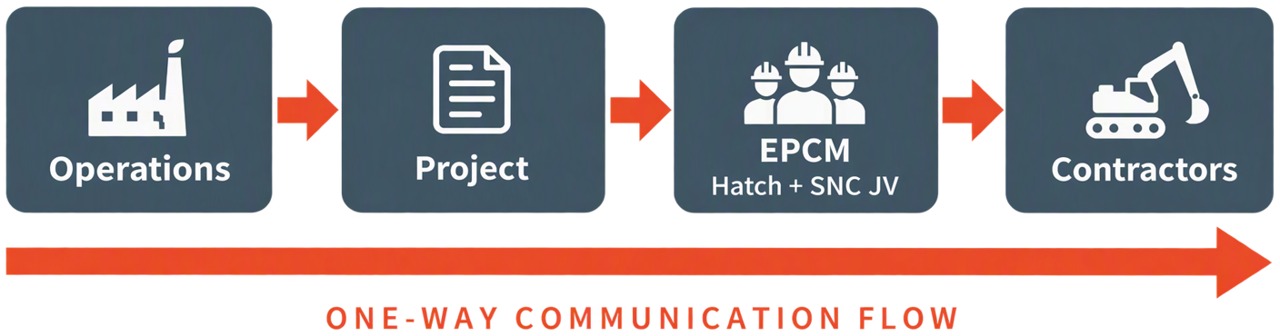
Aluminerie Alouette’s ramp-up success and sustained operational performance is a prime example of how projects can exceed the business case and increase value. Aluminerie Alouette’s concept around communication involved discipline to enable connectivity and effective transfer of information to support decision-making. Equally important to the lines of communication were the rules about non-communication, the rigor to follow the clear lines of communication ensured that the right people were informed and built in logic to the flow of communication as illustrated below.
Read how the Alouette team was organizedShow less
On complex projects, success depends on designing and actively managing communication networks. Small, empowered teams with clear accountability enable faster decisions, better alignment, and effective execution.
The Aluminerie Alouette Project was organized into areas. The operations manager nominated a representative for each area. From day one, the representative was involved in the project which enabled early buy-in, better decision-making, and focused communication on what mattered most to support future operations. A sub-committee of representatives communicated through Hatch. Ultimately, this project achieved spectacular success and serves as an example of the importance of effective communication and respect between teams to support ramp-up performance and continued strong operations.
Another important contributor to the success of the Aluminerie Alouette Project was that operational readiness and commissioning planning started very early in the process using a fully integrated team consisting of project, operations and Hatch team members. This is the ideal set-up such that operational needs are built into project design, procurement, and planning from the outset.
Operational readiness and commissioning planning is key to being able to meet capacity requirements, product quality requirements, and ramp-up in the required timeframe. To learn more, we encourage you to read Part 4 of the series: Enabling strong ramp-up performance with OR.
From handover to continuity
The transition from commissioning to operations is one of the most critical interfaces in any project. It is also one of the least structured. A successful ramp-up requires moving beyond the concept of handover as a single event. Instead, it must be treated as a continuum of ownership and knowledge transfer. This includes:
When this continuity is established, ramp-up becomes a controlled progression, rather than leaving operations to reconstruct understanding under live process conditions.
Key takeaways
Commissioning teams validate that a plant can run. Operations proves that it can perform.
Projects fail when operational reality collides with decisions made long before start-up. Preparing for operational readiness and closing the handover gap is what enables a successful start-up to be a successful operation.
What’s next?
The next phase of this series will explore the importance of the ramp-up capital program.
We welcome your input. Share the topics you would like us to explore in future blogs at britt.mackinnon@hatch.com