Earlier blogs in this series introduced new perspectives on the McNulty curves. This blog dives into why a quarter of all ramp-ups still fail today and addresses the question: what are we missing?
For more than 25 years, the McNulty curves have been shaping how project owners, engineers, and investors think about ramp‑up performance. Based on real project outcomes and empirical data—not theory—they reveal a hard truth: most successes and failures are decided long before commissioning begins.
And yet, in today’s project environment, the same mistakes keep repeating.
Schedules are compressed. New technologies are adopted under pressure. Early studies are abbreviated to secure funding or accelerate sanction decisions. Everyone wants faster delivery, but few stop to ask whether acceleration is being achieved through discipline or optimism.
So, what has actually changed over time? And why do projects with smarter tools, better models, and greater access to data still struggle to reach design capacity? At this year’s World Mining Congress (WMC 2026), our paper “McNulty Curves: New Perspectives to Enable Trust, Transformation, and Technology” will re-examine the legendary curves through a new lens and challenges some widely held assumptions about ramp-up performance.
The curves haven’t changed, but the stakes have…
Since their introduction in 1998, the McNulty curves have tracked ramp-up performance across more than 150 metallurgical and chemical processing projects. Despite decades of innovation, the dominant drivers of success and failure remain surprisingly consistent:
The quality of early technical information
Depth of test work and process understanding
Experience and judgment of the project team
Realism in schedules and capital allocation
… What has changed is the context
Today’s projects are larger, riskier, more constrained, and more visible, often delivering critical minerals under intense market, regulatory, and social pressure. The margin for error during ramp-up has never been smaller.
The question is no longer whether a project can be accelerated, but whether it can be accelerated safely, credibly, and repeatably.
Trust is the real enabler of acceleration
Our paper and presentation explored how the McNulty curves can be used not as historical artifacts, but as a practical framework for trust—trust between owners, delivery partners, and investors.
Trust in ramp-up expectations.
Trust in technology readiness.
Trust that risks are understood, discussed openly, and deliberately managed.
Rather than asking, “How fast can we build and start up?” the curves force a more difficult question:
Which ramp-up profile is this project actually setting itself up to achieve, and why?
New technology isn’t the problem, misuse is.
One of the most persistent myths in capital projects is that new technology automatically leads to poor ramp-up performance. The case histories tell a different story.
Projects using novel processes have achieved successful ramp-ups when introduced with discipline, piloted rigorously, and supported by experienced teams. Conversely, projects built on “proven” technology have failed when delivery strategies ignored constructability, operational readiness, or the realities of start-up resourcing.
The differentiator is not innovation – it is how deliberately the project is designed to transition into operations.
A conversation the industry needs to have (again)
This forthcoming paper and presentation will revisit the McNulty curves not to restate what is already known, but to challenge how they are being interpreted (and too often ignored) in modern projects.
Attendees can expect:
New perspectives on applying the curves to today’s accelerated development models
Insights into how ramp-up performance directly protects or destroys project value
Practical lessons for owners navigating schedule pressure, technology risk, and capital discipline
Since 1998, McNulty has examined project case histories and identified having the right people with common sense/practical wisdom as a characteristic of successful ramp-up performance. Its absence, by contrast, often results in project failure.1 Wasmund also studied project case histories and highlighted the importance of having the right people to enable successful ramp-up. Flyvbjerg similarly stressed the need for project teams to possess phronesis—practical wisdom developed through accumulated knowledge and experience.2
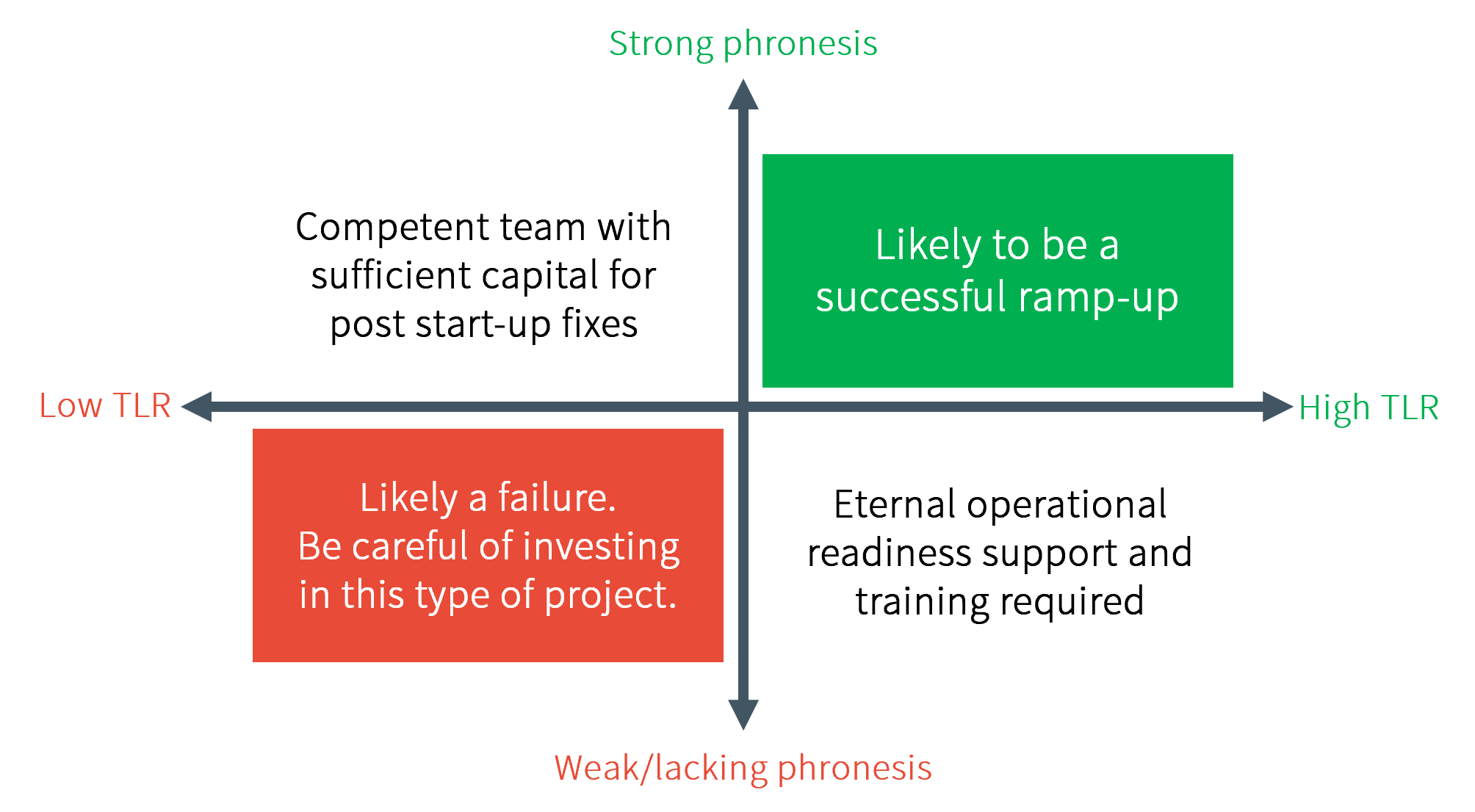
The dilemma is that in the last few decades, many highly experienced engineers, designers, and plant operators have retired, resulting in a loss of phronesis. Enrollment in mineral engineering curricula has steadily declined, requiring substitution with personnel from other disciplines. Personnel shortages have led to advancement beyond the rate of development of experience and judgment. A simple illustration of the role of phronesis in project outcomes is presented by Figure 2. Note: TRL stands for “Technical Readiness Level,” a technology maturity scale developed by NASA in the 1970s.3
The McNulty curves remain relevant for one simple reason: they reflect reality. The question is whether the industry is still willing to listen.
Figure 1. Understanding how the “phronesis” of the project team can impact ramp-up outcomes.
This concept is perhaps best described by Ed Catmull, “If you give a good idea to a mediocre team, they will screw it up. If you give a mediocre idea to a brilliant team, they will either fix it or throw it away and come up with something better.”4
If you’re responsible for setting ramp-up expectations, approving capital, or delivering projects that must work the first time, this is a conversation worth having. Join the discussion at WMC 2026.
What’s next?
The Ramp-up Series: Beyond the curves will share insights about how to set projects up for success. Hatch’s subject matter experts will explore project delivery best practices to support ramp-up success. Together we dive into:
Informed risk taking based on comprehensive development of process design criteria
Why reliability matters
Understanding the key value drivers and KPIs to support ramp-up performance
Innovation in engineering and breakthrough contributions in metallurgical operations
Planning for success and more!
We welcome your input. Share the topics you would like us to explore in future blogs at britt.mackinnon@hatch.com
References
1 McNulty, T. (1998). Innovative technology: Its development and commercialization. In M. Kuhn (Ed.), Managing innovation in the minerals industry (pp. 1–14). Society for Mining, Metallurgy, and Exploration. McNulty, T. (1998). Developing innovative technology. Mining Engineering, 50(10), 50–55.
2 Flyvbjerg, B., & Gardner, D. (2023). How big things get done: The surprising factors that determine the fate of every project, from home renovations to space exploration and everything in between. McClelland & Stewart.
4 Catmull, E., & Wallace, A. (2014). Creativity, Inc. (Expanded edition): Overcoming the unseen forces that stand in the way of true inspiration. Random House of Canada.
Author, Britt MacKinnon will be presenting the topic, McNulty Curves: New Perspectives to Enable Trust, Transformation, and Technology at the World Mining Congress (WMC 2026) in Lima, Peru on Wednesday, June 24 at 3:20 PET.
Britt MacKinnon, P. Eng completed her Applied Sciences degree in Chemical Engineering and Certificate in Business at Queen’s University in 2019, and she was invited back to Queen’s University to deliver the keynote about the importance of ethics in engineering. Britt is part of Hatch's CORE (Commissioning, Operations Readiness, and Ramp-up Excellence) team and is currently on site in Idaho, USA supporting the commissioning of a mill restart. Her work has taken her across the globe to Brisbane, Australia, for nearly two years, beginning in 2023, before being assigned to North Carolina, USA to serve as a process engineer.
Britt serves on the MetSoc Board of Directors as the Sustainability Section Chair and was recognized with a 2021 Association for Iron & Steel Technology (AIST) Presidential Citation for her “contributions as a Young Professional and rising leader in AIST”. AIST is the global leader in networking, education and sustainability programs for advancing iron and steel technology.
Terence (Terry) McNulty
Dr. Terry McNulty is a metallurgical engineer with degrees from Stanford University, Montana Tech, and the Colorado School of Mines. A registered professional engineer, he spent 20 years at the Anaconda Company and later held executive roles at Kerr-McGee Chemical and Hazen Research. In 1988, he co-founded T. P. McNulty and Associates, a global consulting firm. Terry holds two patents in copper metallurgy and has published over 50 technical works. He is a member of several professional societies and was elected to the National Academy of Engineering in 2005. His numerous honors include the Robert H. Richards Award and Distinguished Alumni Awards from Colorado School of Mines and Montana Tech.
Phillip Mackey
Dr. Phillip Mackey is a globally recognized metallurgist known for pioneering copper smelting technologies, including the Noranda Reactor and Converting Processes, which have transformed non-ferrous metallurgy worldwide. Originally from Australia, he earned his BSc and PhD from the University of New South Wales before moving to Canada, where he led innovations at Noranda and later Xstrata. Mackey has authored over 100 technical papers, mentored future metallurgists at Laurentian and McGill, and served as an honorary professor in China. A Fellow of CIM and TMS, his numerous accolades include the Airey Award and the Noranda Technology Award. He continues to contribute through global consulting and board service.