Part 2 of our series showed that strong ramp up performance starts with making deliberate, well informed decisions early, especially on fast tracked projects. In this blog, we take it a step further, exploring how treating commissioning as a strategic, expert led process, with rigorous Stage 3 planning and early risk mitigation sets the foundation for a safer, smoother, and more predictable Stage 4 start up.
Commissioning is typically executed through a series of clearly defined stages, each building on the last to progressively prove equipment, systems, and operations. Understanding what happens at each stage helps teams manage risk, set realistic expectations, and protect long-term project value.
Commissioning Stages
This stage involves final inspections and adjustments to verify that equipment and systems are installed per the design and meet construction quality standards. Activities include mechanical clearances, torque checks, piping pressure tests, electrical continuity and insulation testing, and verification of safety devices. Completion is confirmed through turnover walkdowns and acceptance of turnover documentation, ensuring that all assets are properly installed and have passed construction quality checks.
Individual equipment components are energized and tested to confirm safe and reliable function. This includes motor bump tests, control system communication checks, and verification of interlocks. Equipment must be operable from the plant control system, with all field devices communicating properly. Successful completion of this stage confirms that each component functions as intended and marks the ready-for-commissioning milestone.
Subsystems are dynamically tested using inert materials such as water, air, or nitrogen to simulate process conditions. Coupled equipment runs, control sequence validation, and instrumentation calibration are performed. Systems are operated in sequence to verify control logic and interlocks. This stage validates system-level functionality as much as possible without introducing process feed, culminating in the ready-for-start-up milestone.
Start-up initiates plant operations using process materials, progressively increasing production rates to predefined milestone levels. Managed by operations under the pre-startup safety review framework, and executed by commissioning with vendor and automation support, this phase confirms system performance under live operating conditions. Completion is validated through operational trials and resolution of deficiencies, with sign-off of the Stage 4 certificate and issuance of the final acceptance certificate indicating readiness for continuous operation.
Ramp-up transitions the facility to sustained, steady-state operation at nameplate capacity. Led by operations with vendor support as needed, this phase confirms that all systems are operating reliably and in accordance with design intent. Full performance and functional benchmarks must be achieved, and any remaining deficiencies resolved. Completion of this stage marks the final handover of the facility.
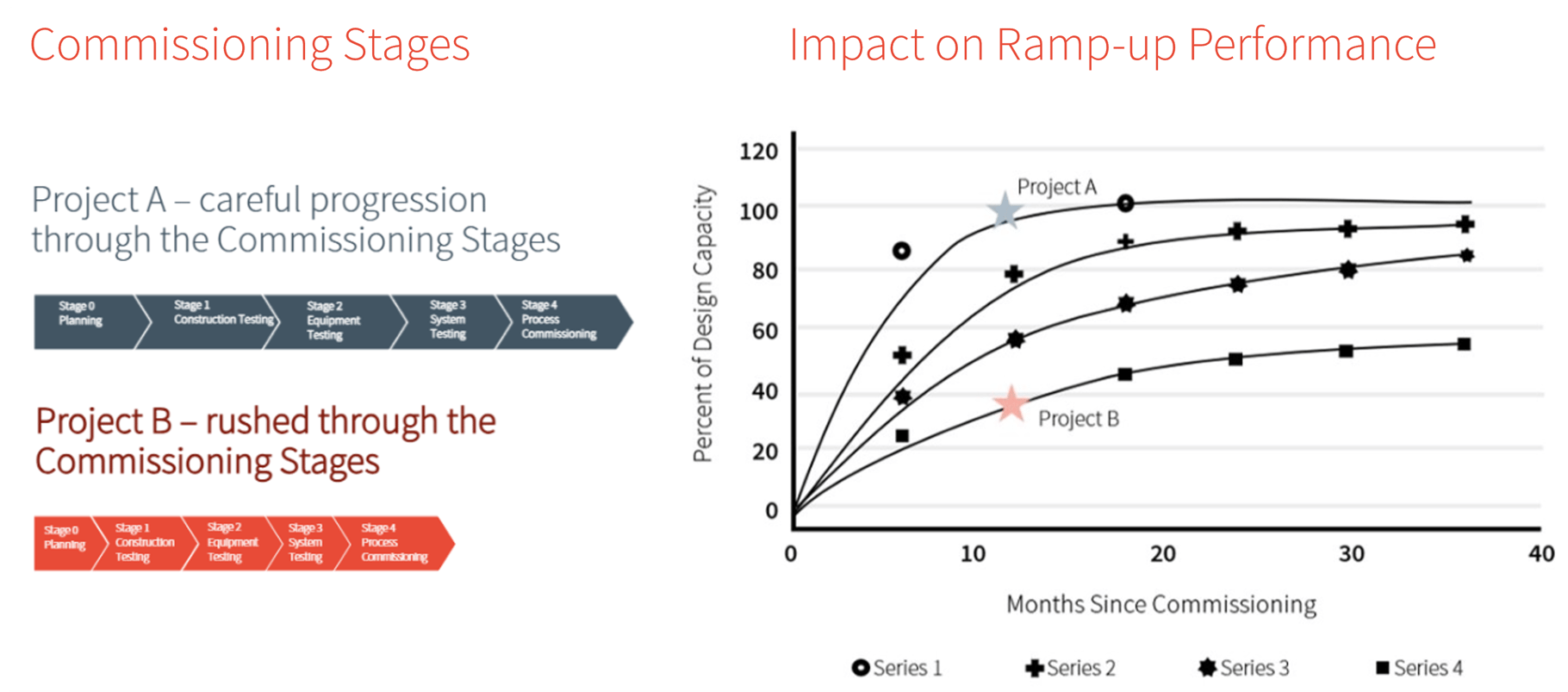
Can we compress these Commissioning Stages? Let’s see what happens if we do so. Figure 1 below compares two hypothetical projects: Project A and Project B.
Project A follows a realistic timeline to complete the Commissioning Stages. A diligent team conducts a detailed risk review during Stage 3, identifies risks early, and develops mitigation plans. As a result, this project is well-prepared for Stage 4 ramp-up and follows the Series 1 curve, generating stronger long-term cash inflow and maximizing expected NPV.
In contrast, Project B compresses the commissioning stages and takes short-cuts. During Stage 4 ramp-up, the project faces unforeseen risks that negatively impact its ramp-up performance, resulting in it being closer to the Series 3 or 4 curve, destroying value and eroding the business case.
The above figures compare a fast-tracked project timeline with a timeline informed by benchmarking data for Commissioning Stages and a theoretical representation of the fast-tracking impact on ramp-up performance.
When it comes to commissioning, start-up, and ramp-up, success isn’t something that happens by chance during Stage 4. It’s the result of meticulous planning and rigorous testing during Stage 3. The transition from system testing to process commissioning is one of the most critical phases in any project… and getting it right can mean the difference between a safe and smooth ramp-up versus a dangerous one with costly delays.
Why Stage 3 matters
Stage 3 is where systems are validated under inert conditions. This phase ensures that safety systems, equipment, and controls work as intended before introducing process materials. It’s the time to confirm interlocks, alarms, and sequences, and to validate control philosophies. Skipping or rushing through this stage can result in major issues later, when the stakes are significantly higher.
A well-structured Stage 3 plan sets clear boundaries for safe testing and handover. It includes:
Detailed execution plans approved by the owner.
Scoped drawings and system lists to define battery limits.
Isolation procedures and safety transition plans to manage energization risks.
Vendor readiness plans to ensure support during commissioning.
These deliverables aren’t just paperwork—they’re the backbone of a controlled commissioning process. The importance of “doing your homework” and proper planning is demonstrated by successful versus failed projects.
How does Pixar’s process relate to commissioning?
Pixar is a well-known example of how a rigorous, multistage production process drives success by identifying and correcting flaws early. Its approach is built around four key phases: development, pre-production, production, and post-production. Similar to the Pixar process, our commissioning stages enable early risk identification, which allows the team the ability to pivot and better align themselves toward achieving successful outcomes.
Carefully conducting thorough risk reviews on commissioning procedures, developing job hazard analyses, and maintaining an up-to-date risk register allows teams to anticipate potential failure modes. Mitigation strategies such as early testing of long-lead equipment, securing critical spares, and scheduling vendor support serve to reduce uncertainty and prevent last-minute corrective actions.
Early risk management and mitigation
Risk management during Stage 3 is essential. Stage 3 establishes a baseline for equipment operating conditions where upper and lower bounds are tested. Stage 4 references this baseline. For examples, a pump curve is tested and baseline set in Stage 3, then used as reference in Stage 4.
Stage 4 isn’t routine
Stage 4 is where process materials are introduced and systems operate under live processing conditions (high temperature, high pressure, etc.). Unlike steady-state operations, this phase is dynamic and high-risk. It requires:
Integrated teams combining operations, maintenance, and commissioning personnel.
Expert support for critical equipment and process control systems.
Rapid decision-making authority to address issues quickly.
Engaging industry experts early in the planning process is key to the development of robust mitigation plans and provides specialized knowledge for complex systems. This is not the time for improvisation. Stage 4 demands precision and experience.
Controlled ramp-up
When Stage 3 planning is thorough, Stage 4 becomes a controlled exercise rather than a scramble. The benefits are clear:
Safer and faster ramp-up to nameplate capacity.
Reduced downtime and fewer surprises.
Significant business value, as demonstrated by real-world examples where proper planning shaved months off ramp-up schedules and delivered added value.
Key takeaways
Invest in Stage 3 planning with the understanding of the transition to Stage 4, as this will be the foundation for success.
Identify and mitigate risks early to avoid safety incidents and costly delays.
Recognize that Stage 4 is a specialized, high-risk phase requiring expert involvement.
Treat commissioning as a strategic process, not a checklist.
What’s next?
The Ramp-up Series: Beyond the Curves will share insights about how to set projects up for success. Hatch’s subject matter experts will explore project delivery best practices to support ramp-up success. Together we dive into:
Achieving excellence in ramp-up
De-bottlenecking studies and upgrades
Breakthrough contributions in metallurgical operations
Planning for success and more!
We welcome your input. Share the topics you would like us to explore in future blogs at britt.mackinnon@hatch.com
Britt MacKinnon
Process Engineer, CORE
Britt MacKinnon, P. Eng completed her Applied Sciences degree in Chemical Engineering and Certificate in Business at Queen’s University in 2019, and she was invited back to Queen’s University to deliver the keynote about the importance of ethics in engineering. Britt is part of Hatch's CORE (Commissioning, Operations Readiness, and Ramp-up Excellence) team and is currently on site in Idaho, USA supporting the commissioning of a mill restart. Her work has taken her across the globe to Brisbane, Australia, for nearly two years, beginning in 2023, before being assigned to North Carolina, USA to serve as a process engineer.
Britt serves on the MetSoc Board of Directors as the Sustainability Section Chair and was recognized with a 2021 Association for Iron & Steel Technology (AIST) Presidential Citation for her “contributions as a Young Professional and rising leader in AIST”. AIST is the global leader in networking, education and sustainability programs for advancing iron and steel technology.
Josh Lilley
Global Director, Commissioning, CORE
Josh Lilley is Global Director, Commissioning within Hatch’s CORE business practice. He brings over two decades of commissioning experience in the mining sector, spanning mines, mills, and smelters. Josh’s work covers the full project lifecycle from early planning through to execution, giving him deep expertise in both greenfield and brownfield environments. He is focused on ensuring equipment is commissioned correctly and that projects start up in a safe, controlled, and reliable manner.
Our perspectives
More conversations about the world's biggest challenges