Part 1 introduced new perspectives on the McNulty curves for capital project success and identified key relationships between project characteristics and their ramp-up performance. In this blog, we shift our focus to proactive risk management and its impact on ramp-up performance and achieving business objectives.
Back to the basics: Understanding your business environment
In today’s volatile market of increasing uncertainty and complexity, it is more important than ever to have a clear, upfront understanding of business objectives and ensure full alignment with the project execution plans. This is critical to maximizing returns and unlocking a project’s full potential. Current trends show that mature organizations and leading clients are constantly navigating trade-offs between competing objectives in response to market volatility and intense competitiveness. For example, the decision to schedule sufficient time to carefully plan and design a robust project to enable a successful ramp-up to maximize net present value (NPV) versus accelerate execution (reducing planning time with the hope to achieve speed-to-market) to capture market share faster represents two distinct objectives. These desired outcomes demand different thinking and often entirely different execution strategies. The real question is: How can we meet business objectives without compromising project fundamentals, especially in fast-tracked projects?
Project fast-tracking and its impact on ramp-up performance
Speed to market is now a top priority for many. Design for speed is increasingly becoming an important differentiator that supports competitive advantages in the current environment of fast-changing technology and evolving customer needs. Often, it requires project fast-tracking, commonly referred to as the “rapid application development model,” which has become prevalent, especially in industries with highly competitive markets. However, while project fast-tracking can unlock significant opportunities across the project life cycle it should be treated with caution as there are some inherent dangers with taking shortcuts to speed up delivery.
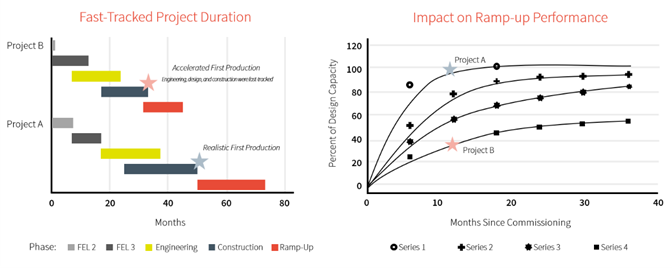
For instance, the figure below compares two hypothetical projects: Project A and Project B.
Project A follows a realistic timeline. A diligent team completes engineering studies upfront and meets the required maturity level of project definition at each gate in accordance with the Association for the Advancement of Cost Engineering (AACE) guidelines. As a result, it is expected to achieve a successful ramp-up that follows the Series 1 curve, generating stronger long-term cash inflow and maximizing expected NPV.
In contrast, Project B increases schedule overlap to enable an earlier construction start, proceeding without a fully phased, staged gate approach. As a result, the project is expected to encounter unforeseen risks shortly after start up, which could negatively impact ramp-up performance—trending closer to a Series 3 or 4 curve—despite the intent to capture market share more rapidly.
Figure 1: Comparison of a fast-tracked project timeline with a timeline informed by benchmarking data and a theoretical representation of the fast-tracking impact on ramp-up performance
Informed risk-taking: Time-cost trade-off
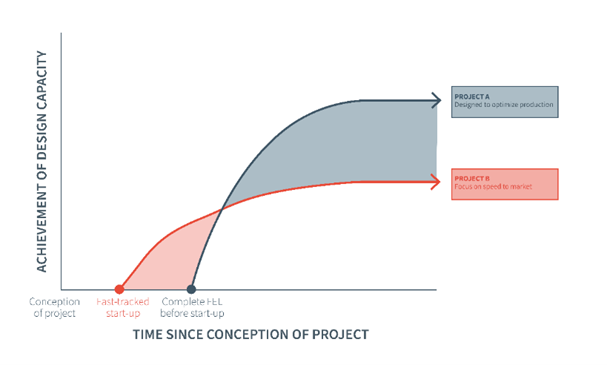
The above Project A versus Project B scenario raises a key question: Is faster always better? If yes, then would the early revenue generated by accelerating execution offset the potential long-term revenue loss caused by ramp-up performance issues? Addressing these questions requires a careful, risk-based cost-time trade-off analysis to identify and evaluate the magnitude of threats and opportunities, aligned with market evidence, client risk appetite, risk acceptance thresholds, and long-term business objectives. A visualization of these two scenarios is shown below.
Figure 2: Example of ramp-up performance across two hypothetical projects
Quantifying the long-term revenue loss caused by poor ramp-up performance versus the early revenue gained from faster market entry demands extensive data and historical evidence. Literature consistently shows that late and poor ramp-ups often carry significant costs over the project life cycle and long-term revenue loss. For example, an empirical study of 51 U.S. process plants assessed ramp-up time and its impact on cost as a percentage of construction capital. According to this research, when ramp-up time in the studied projects increased from four months (median) to eight months (mean), ramp-up costs rose from 3.6% to 5.5% of construction capital, a ~2% increase that can equate to hundreds of millions of dollars in large-scale projects. A key driver of this increased cost is aggressive schedule acceleration. But can faster execution lead to cheaper delivery? This controversial question demands innovative risk thinking and creative risk mitigation approaches.
Shifting risk awareness upstream: A smarter path to predictability and effective ramp-up
Decisions made in the early stages of project development can have a major impact on achieving business objectives during future phases of the project life cycle. The literature in both academia and industry studies indicates that fast-tracking should be considered based on project-specific characteristics, including but not limited to the level of complexity and technology involved. For business success, maturity should be understood primarily in organizational terms rather than purely technical design readiness. The maturity of the owner organization and the broader ecosystem supporting the facility, including delivery partners, operators, regulators, and the local supply chain, plays a critical role in determining how much schedule overlap can be responsibly absorbed. Equally important is the organization’s familiarity with the type of project being executed. Relevant factors include whether the work involves brownfield or greenfield development, is in a new country or near existing assets, or is based on a familiar process versus a new technology or product with limited in-house expertise. These factors materially influence risk exposure during execution and ramp-up and represent a key consideration when advising clients on the appropriate degree of fast tracking for a given project. Early identification and mitigation of these risks to reduce their residual impact improves ramp-up performance and leads to faster, more cost-effective delivery. When deciding if to fasttrack a project, it is critical to establish a clear understanding of the risks involved and how the parties responsible for delivery will proactively manage them.
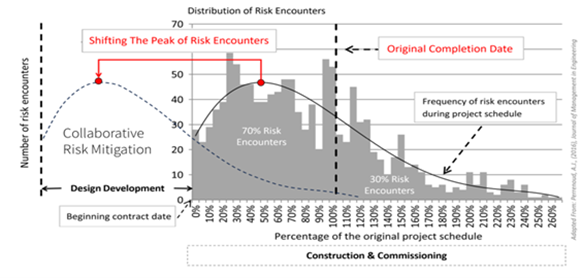
When risks are collaboratively identified, shared, owned, and communicated early, project teams are better equipped to control cost escalations and schedule delays, ultimately boosting trust with better predictability and enhancing customer satisfaction. However, empirical evidence shows that in construction projects, risks are often identified and addressed too late. For example, a study of 229 small construction projects in the U.S. found that 70% of risk encounters occurred before the original completion date, while the remaining 30% occurred afterward, which is far too late for effective resolution and often results in costly consequences. This pattern is largely driven by delays in communicating risks and late and ineffective implementation of risk treatment plans and mitigation strategies. These delays contribute directly to ramp-up schedule slippage, cost overruns, and lost revenue.
Wouldn’t it be better to shift this peak from construction to project development phase (as illustrated below)?
Doing so would allow project teams to safely and effectively accelerate execution, achieving both speed to market and strong ramp-up performance—potentially even outperforming the Series 1 curve.
Figure 3: Example of shifting the peak of risk encounters from the construction and commissioning phases to the design development phase
At Hatch, we work closely with our clients to reduce variability and bring greater predictability to complex projects. This involves early collaboration with our clients and multiple partners during the initial stages of project development to ensure alignment on long term objectives for successful delivery. It also includes aligning on the use of digital tools, the level of technology deployment, and the necessary steps for full integration of procedures based on industry best practices. This approach enhances collaboration, builds trust, and improves productivity.
Managing the trade-offs between speed, design requirements, and ramp-up schedules takes more than a single approach. We use advanced digital tools, including large language models, to uncover patterns across projects and deliver early, real-time warnings that lead to timely, proactive decisions when and where they matter most. We also engage contractors and partners early to improve onsite efficiency and strengthen the integration of digital tools, enhancing collaboration and productivity.
In the end, resilience isn’t about avoiding the unexpected, it’s about being ready for it.
What black swan events have you encountered, or wondered about? Reach out to us and we can explore them together.
What’s next?
The ramp-up series: Beyond the curves will continue to share insights about how to set projects up for success. Hatch’s subject matter experts will explore project delivery best practices to support ramp-up success. Together we dive into:
Informed risk-taking
Megaproject governance
Achieving excellence in ramp-up
De-bottlenecking studies and upgrades
Innovation in engineering
Breakthrough contributions in metallurgical operations
Planning for success
References
McNulty, T. (1998) Innovative technology: its development and commercialization. In: Kuhn M (ed) Managing innovation in the minerals industry. SME: 1-14.
McNulty, T. (1998) “Developing Innovative Technology”, Mining Engineering, vol. 50, no. 10, October 1998, pp. 50–55.
McNulty, T., MacKinnon, B., Mackey, P. (2025). McNulty Curves—An Update and New Perspectives. In: 12th International Copper Conference. COPR 2025. Springer, Cham. https://doi.org/10.1007/978-3-032-00102-3_102
Myers, Christopher W., Ralph F. Shangraw, Mark R. Devey, and Toshi Hayashi. Understanding process plant schedule slippage and startup costs. Rand, 1986.
Perrenoud, Anthony J., Jake B. Smithwick, Kristen C. Hurtado, and Kenneth T. Sullivan. "Project risk distribution during the construction phase of small building projects." Journal of Management in Engineering 32, no. 3 (2016): 04015050.
Authors
Lise Bouchard
Isabelle Plante
Josh Lilley
Britt MacKinnon
James Marzocca
Nils Voermann
Dr. Moe Roghabadi
Our perspectives
More conversations about the world's biggest challenges