Earlier blogs in this series introduced new perspectives on the McNulty curves. This blog focuses on the importance of operational readiness (OR) when it comes to reducing risk and enabling a strong ramp-up. Building an asset is only part of the equation. Success depends on operating it effectively to deliver the business case. OR aligns vision, execution, and momentum to ensure a smooth start-up and ramp-up.
"Regardless of the extent to which it depends on innovative technology, a successful project requires sensible corporate management, experienced project management and adequate support from specialized professionals in process development, equipment design, and engineering … There is nothing new in these conclusions. Most readers, though, will remember a failure that could have been prevented if someone had convinced senior management that the project was straying from a course dictated by good judgment and common sense."1
Operational readiness (OR) and ramp-up are specialized disciplines built on component‑level planning, skilled teams, and integrated digital tools that ensure a smooth, failure‑free transition to operations. Industry data underscores the stakes:
"A study of some 16,000 major projects—from large buildings to bridges, dams, power stations, rockets, railroads, information technology systems, and even the Olympic Games—reveals a massive project-management problem. Only 8.5% of those projects were delivered on time and on budget, while a mere 0.5% were completed on time and on budget and produced the expected benefits. In other words, 99.5% of large projects failed to deliver as promised."2
Evidently, insufficient readiness can erode project net present value. These insights further strengthen the argument that embedding OR early is essential to protecting and realizing value during ramp‑up.
OR prepares people, systems, and processes to assume responsibility for new assets safely and effectively. It ensures teams are trained, systems are in place, and procedures are understood—enabling commissioning, start-up, and ramp-up success.
How OR enables people to work together and make sound decisions under pressure:
People are trained and capable
The operating systems and equipment they need are in place
The processes and procedures they work to are available and known
Roles and accountabilities are understood
OR is key to being able to meet capacity requirements, product quality requirements, and ramp-up in the required timeframe.
Warren Buffett famously stated, "Price is what you pay; value is what you get," highlighting the distinction between the cost and its true worth.
What is the value of OR?
Value add: Embed OR early, align design with operational goals, and foster shared ownership.
Value protect: Use experienced, cross-functional teams, validated processes, and transparent reporting.
Value realization: Sustain capability, monitor integration risks, and maintain continuous improvement tied to the business case.
When operations begin, success is measured by business performance, not construction milestones. OR ensures projects deliver on their promises and exceed expectations.
Timely engagement of OR, either dedicated or seconded to the project, ensures that design and construction risks are prevented and people, systems, and processes are enabled to ensure safe and efficient operations. The ultimate measure of success for a business is not project completion but outcome assurance. When issues such as mass/water balance, mining strip ratio, and environmental permitting or community requirements are not addressed early, their effects are compounded as project development evolves, causing insufficient water intake, overconsumption of fuel and tires, and delays in securing the license to operate, among other impacts.
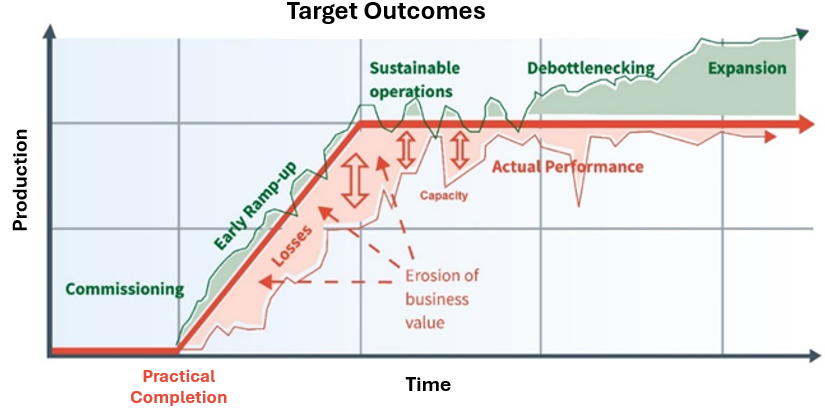
The following graphic illustrates the journey from commissioning to full operational performance, showing how production ramps-up over time and where value is either gained or lost.
When should OR start?
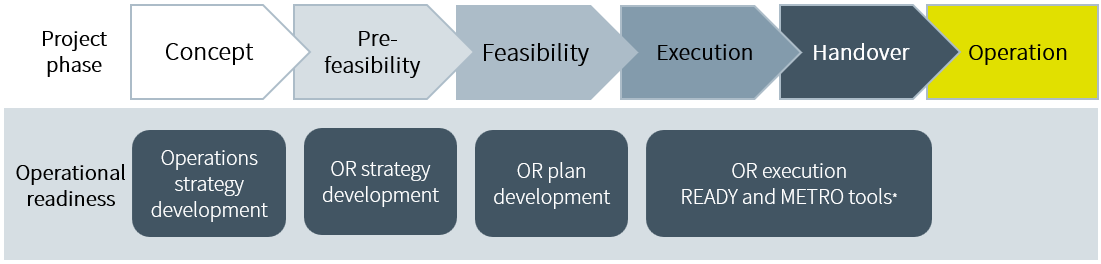
Ideally, OR should commence during the concept project phase, so that operational needs are built into project design, procurement, and planning from the outset. The reality is that OR is often first considered in later project phases. It ramps-up in parallel with project delivery, becoming a focused workstream as systems move from static to dynamic commissioning, ensuring the site is truly ready to operate on Day 1.
The graphic below illustrates how operational readiness should ideally be integrated across the full project lifecycle, evolving from early strategy through to execution and handover into operations.
*READY and METRO are Hatch's integrated project execution tools that bring clarity to complex delivery environments. READY manages scope, schedule, and progress through earned value-based work management, while METRO visually integrates milestones across multiple schedules to quickly identify risks and impacts. Together, they enable confident, informed project decisions.
How to develop a fit-for-purpose OR program
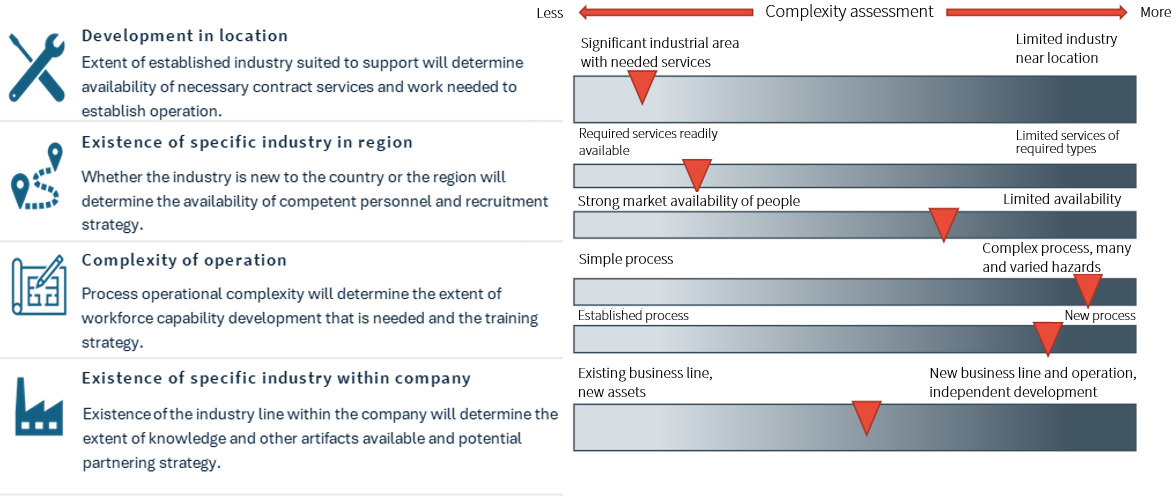
An OR program should enable an organization to establish operational practice. The more challenging the operation, the more comprehensive the program needs to be.
The following is a complexity assessment framework for developing an operational readiness program showing how different contextual factors influence how simple or complex a program needs to be.
OR management
Hatch takes an "integrated team" approach to drive the execution effort toward handover and start-up. The framework focuses on establishing and embedding business-as-usual practices to complete the OR work program, which includes being prepared for commissioning and ramp-up.
Outcomes:
Integrated governance and risk management to ensure OR is an integral part of the design and implementation, as well as incorporating OR-related risks as part of the enterprise risk management
A dedicated team to drive the execution effort using a structured approach
Driving accountability and ownership of progress reporting
An understanding where energy should be focused
Broken down barriers between functions and the creation of a collaborative culture
An ability to deliver the OR scope as planned
Ultimately, OR protects the business case. It safeguards the project's return on investment by ensuring the operation delivers planned performance, cost, and schedule outcomes.
Metrics and KPIs
The term "metric" is generic, whereas a key performance indicator (KPI) is specific. KPIs serve as early warning signs that, if an unfavorable condition exists and is not addressed, the results could be unfavorable. A future blog in the series will dive deeper into how OR selects metrics and KPIs to achieve excellence in ramp-up; therefore adding, protecting, and realizing both strategic value and business value.
What's next?
The Ramp-up Series: Beyond the Curves will share insights about how to set projects up for success. Hatch's subject matter experts will explore project delivery best practices to support ramp-up success. Together, we will dive into:
Why reliability matters
Understanding the key value drivers and KPIs to support ramp-up performance
Innovation in engineering and breakthrough contributions in metallurgical operations
Planning for success and more!
We welcome your input. Share the topics you would like us to explore in future blogs at britt.mackinnon@hatch.com
References
[1] McNulty, T. (1998). Innovative technology: Its development and commercialization. In M. Kuhn (Ed.), Managing innovation in the minerals industry (pp. 1-14). Society for Mining, Metallurgy, and Exploration. McNulty, T. (1998). Innovative technology. Mining Engineering, 50(10), 50-55.
[2] Flyvbjerg, Bent and Gardner, Dan, How Frank Gehry Delivers on Time and on Budget: Lessons from the Master Architect in Managing Big Projects (January 3, 2023). Harvard Business Review, January-February 2023, Available at SSRN: https://ssrn.com/abstract=4317294
Britt MacKinnon
Process Engineer, CORE
Britt MacKinnon, P. Eng completed her Applied Sciences degree in Chemical Engineering and Certificate in Business at Queen’s University in 2019, and she was invited back to Queen’s University to deliver the keynote about the importance of ethics in engineering. Britt is part of Hatch's CORE (Commissioning, Operations Readiness, and Ramp-up Excellence) team and is currently on site in Idaho, USA supporting the commissioning of a mill restart. Her work has taken her across the globe to Brisbane, Australia, for nearly two years, beginning in 2023, before being assigned to North Carolina, USA to serve as a process engineer.
Britt serves on the MetSoc Board of Directors as the Sustainability Section Chair and was recognized with a 2021 Association for Iron & Steel Technology (AIST) Presidential Citation for her “contributions as a Young Professional and rising leader in AIST”. AIST is the global leader in networking, education and sustainability programs for advancing iron and steel technology.
Alan Cajueiro
Operational Readiness Specialist, CORE
Alan is a member of Hatch’s CORE (Commissioning, Operational Readiness, and Ramp-up Excellence) team in Western Canada. With more than 20 years of experience, he brings global expertise in implementing asset management practices, operational readiness frameworks, and operational excellence programs. His background also includes hands-on field experience in reliability and commissioning, along with leading teams to deliver continuous improvement initiatives. Having spent the early part of his career on the owner’s side and the past decade in consulting, Alan offers a balanced perspective that enables him to effectively support clients across the full project lifecycle.
Kerry Hill
Global Director, Operational Readiness, CORE
Kerry Hill is the Global Director of Operational Readiness, within Hatch’s CORE (Commissioning, Operations Readiness and Ramp-up Excellence) practice. She has over 22 years of experience in operational readiness, asset management and project delivery, including extensive operational, maintenance and engineering leadership experience in the metals, mining, energy and infrastructure sectors. Her background spans across the value chain and life cycle of large-scale lithium, power generation, and oil and gas assets.
Our perspectives
More conversations about the world's biggest challenges