Ramp-up success isn’t about speed alone. It’s about sustainable positive outcomes. Reliability ensures that when we push harder, we don’t break faster.
The principles discussed in this blog are influenced by the work of reliability and operational excellence thought leader, Ron Moore, and many other reliability practitioners who have advanced the discipline through sharing their experiences.
Why reliability matters during ramp-up
Ramp-up periods are inherently unstable. Equipment and processes are brought to life and teams are activated to deliver the outcomes the business needs to deliver the project’s promised value. It’s also the time when deficiencies surface and must be dealt with safely, quickly and efficiently to protect the investment of construction and realize the delivery of value to the business. Beyond ramp-up, the asset also needs to deliver the value reliably over its lifetime.
Unfortunately, history is filled with projects that for one reason or another failed to deliver the value that their business case promised. We love to share good news stories, but we need to also learn the hard lessons that failure teaches us. Typically, the seeds of failure surface during the ramp-up phase. What examples are you aware of or have experienced directly? Share your lessons learned in the comments and help advance the conversation around reliable project delivery.
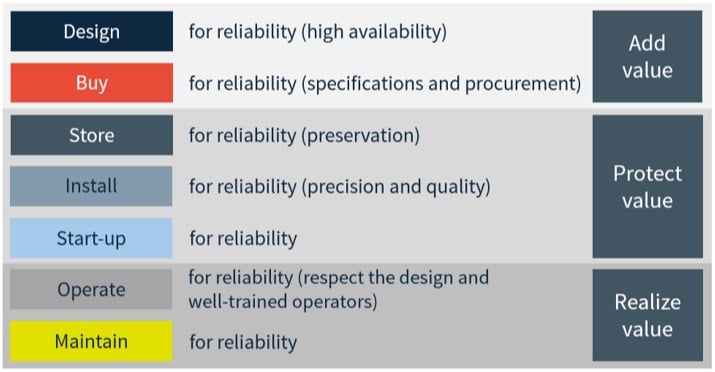
Often, it’s death by a thousand cuts. Delays during start-up and ramp-up put more pressure on commissioning and operating teams, more pressure on existing operations, and can trigger safety incidents, loss of morale, staff turnover, difficulty recruiting, and higher operating costs. Part of the solution is to design a reliable plant, purchase and construct with reliability in mind, commission and start-up with reliability in mind, and then operate and maintain the plant reliably.
Figure 1: Building reliability from design to maintenance
Design for reliability
Defects erode value over time. Too many defects can result in significant downtime, possibly making the project a write-off. To avoid these costly defects, we need to intentionally design for reliability. This can be achieved by applying the following:
Use life-cycle costing.
Apply availability targets in the design.
Design for maintainability by providing safe access, lifting points, and adequate working space.
Apply a standardization policy.
Ensure that vendor support will be available.
Utilize operations and a maintenance knowledge base.
Buy for reliability
Procurement decisions have a direct impact on long-term asset performance.
Consider the following:
Apply life cycle costing.
Include clauses for supply of drawings, manuals, spare parts details, tools, accessories, quality, vendor support, cost of spares, availability of spares, and delivery time of spares.
Consider energy efficiency, capability, service factors, maintainability, operability, options to increase reliability, warranty, and industry performance history.
Store for reliability
Reliability can be compromised before equipment is ever installed.
Best practices include:
Apply best preservation principles during the construction phase.
Design and build appropriate warehouse storage early.
Have spares available for commissioning.
Inspect all new spares.
Use an owner’s maintenance team to execute preservation tasks during construction phase.
Install for reliability
Installation quality plays a significant role in future asset performance.
Focus areas include:
Quality control and inspection and test plans with hold points.
Welding quality processes with independent quality assurance.
Quality flange closure and bolt torquing practices.
Precision alignment, filtering of oils, access to lube points, and labeling.
No induced stresses in piping and precision fitting of equipment.
Cable laying QA, including earthing and termination.
Clean and witness equipment prior to first fills.
Start-up for reliability
Commissioning and start-up establish the foundation for long-term operating performance.
Learn more about how to commission rigorously and set the stage for success by reading The Ramp-up Series: Beyond the Curves | Part 3 and by connecting with Hatch’s subject matter experts.
Operate for reliability
Create ownership through the development of:
Equipment care routes, defect reporting, cleaning and lubrication by operators.
Re-commissioning after maintenance.
Effective shift communication.
Maintain for reliability
Maintenance is often viewed as the reliability function. but in reality, it is the final reliability function. Reliability begins with design and extends throughout the asset lifecycle.
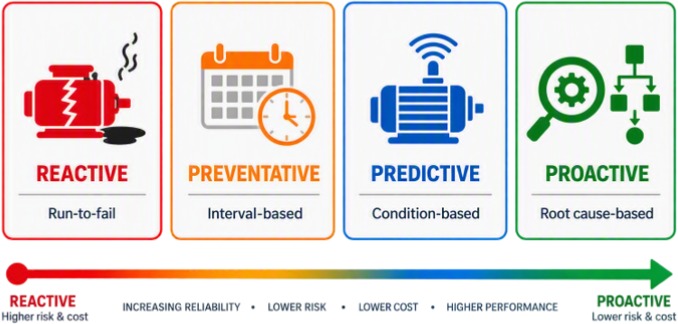
Maintenance strategies generally fall into the four categories identified below.
Figure 2: Asset maintenance strategies
Which maintenance do you use? What reliability KPIs do you use?
Use dashboards and analytics to track reliability KPIs and link them directly to production and cost outcomes to understand the true value of reliability.
Reliability improvements enable both technical and financial wins. By reducing process and yield losses and improving asset availability, organizations can:
Increase production capacity sustainably.
Lower cost per unit, driven by throughput gains and reduced maintenance spend.
Exceed their business case and deliver extra value.
Reliability is the bridge between ambition and achievement. If you want to achieve Series 1 ramp-up performance, or better, you need to care about reliability.
What’s next?
In the next part of this series, we will explore how performance metrics can reinforce accountability by connecting early decisions to measurable outcomes during commissioning and ramp-up.
We welcome your input. Please share the topics you would like us to explore in future blogs at britt.mackinnon@hatch.com.
Britt MacKinnon
Process Engineer, CORE
Britt MacKinnon, P. Eng completed her Applied Sciences degree in Chemical Engineering and Certificate in Business at Queen’s University in 2019, and she was invited back to Queen’s University to deliver the keynote about the importance of ethics in engineering. Britt is part of Hatch's CORE (Commissioning, Operations Readiness, and Ramp-up Excellence) team and is currently on site in Idaho, USA supporting the commissioning of a mill restart. Her work has taken her across the globe to Brisbane, Australia, for nearly two years, beginning in 2023, before being assigned to North Carolina, USA to serve as a process engineer.
Britt serves on the MetSoc Board of Directors as the Sustainability Section Chair and was recognized with a 2021 Association for Iron & Steel Technology (AIST) Presidential Citation for her “contributions as a Young Professional and rising leader in AIST”. AIST is the global leader in networking, education and sustainability programs for advancing iron and steel technology.
Robert Hocking
Global Director, Asset Maintenance, CORE
Rob Hocking is Global Director, Asset Maintenance within Hatch’s CORE business practice. He brings nearly four decades of maintenance, operations, and production experience across the aluminium, energy, and manufacturing sectors. Rob specializes in asset maintenance, operational readiness, and ramp-up, helping clients prepare for and navigate the risks and uncertainties associated with the transition from project delivery to steady-state operations. He works with project teams and asset owners to develop practical maintenance and reliability strategies that support safe, reliable, and sustainable operational performance.
Our perspectives
More conversations about the world's biggest challenges