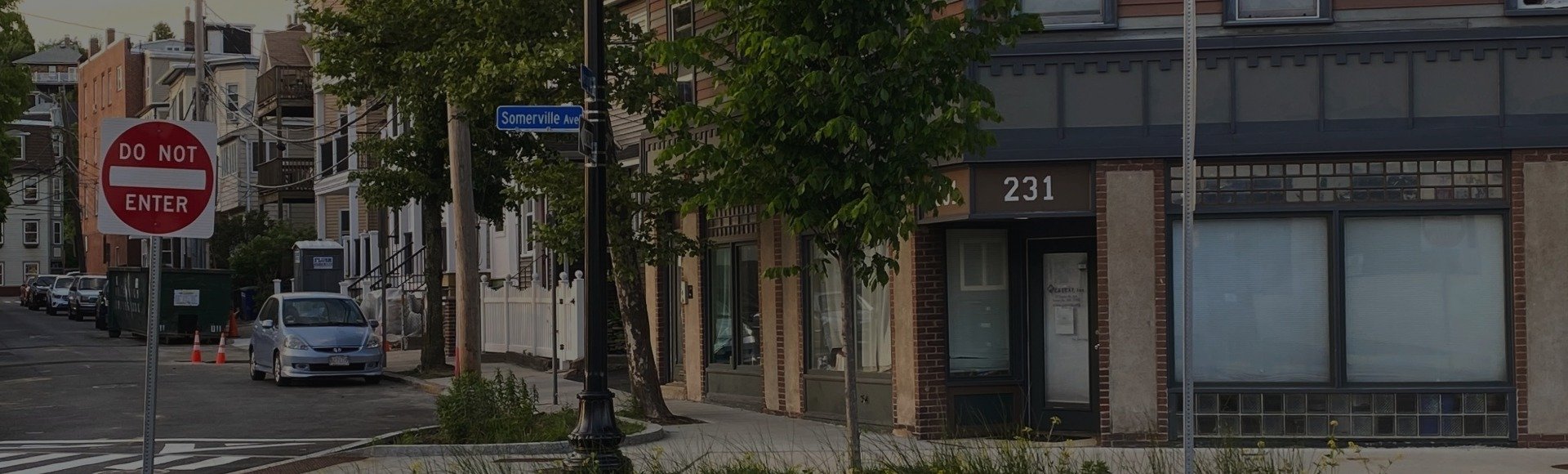
Somerville Avenue Streetscape and Utility Improvement Project
Complete streets and green infrastructure transformation within one of New England’s most densely developed urban corridors.
City of Somerville, Public Works Department
|
Somerville Avenue, Somerville, Massachusetts
|
2016-2023
Award: Boston Society of Landscape Architects (BSLA) Honor Award (2026)
Reduces flood risk through expanded stormwater storage
Significantly enhances mobility and supports transit-oriented development
Challenges
- Supporting Union Square neighborhood’s revitalization by upgrading streets, utilities, and mobility infrastructure, including a new Green Line light rail station.
- Integrating sustainable, low‑maintenance streetscape solutions that enhance accessibility, safety, and environmental performance.
- Addressing stormwater and flood-management needs through Low Impact Development (LID) strategies, and fitting new green infrastructure within existing slopes, utilities, and dense urban conditions.
- Balancing ecological goals with functional needs, while addressing flooding, accessibility, and traffic concerns, and achieving aesthetic improvements in a constrained streetscape.
Solutions
- Delivered integrated engineering, landscape architecture, and ecological services to develop LID strategies.
- Conducted detailed analyses—soils, slopes, permeability, utilities, and hydrology—to optimally site green infrastructure within complex urban constraints.
- Designed innovative stormwater features, including bioretention basins, stormwater planters, tree trenches with Silva Cells, permeable pavers, and a porous asphalt cycle track.
- Developed sustainable, accessible streetscape concepts that addressed flooding, traffic conflicts, and aesthetic goals through coordinated conceptual and schematic designs.
Highlights
- American Council of Engineering Companies (ACEC) National Recognition Award (2024)
- CMMA Project Achievement Award for Infrastructure Projects under $100 million (2024)
- Use of natural sustainable systems
- Complete and green street design
- Conforms to National Pollutant Discharge Elimination System Phase II stormwater requirements
- Achieved significant water quality enhancement through pollutant removal
- Historic urban context
- Cold-weather, natural systems-based design
- Public meeting presentations
- Site investigation and analysis
- Conceptual and schematic design development
- Hydrologic calculations
- Cost estimating
- Stormwater management
- Groundwater mounding studies and pollutant removal estimates
- Contract documents
- Construction oversight and administration
Project Numbers
50-plus new street trees planted to enhance environmental performance along the streetscape corridor
Almost 800 soil cells, providing approximately 16,700 ft³ of soil volume, were installed
1.5 inches of runoff managed through green infrastructure systems capturing 25% of the project area
12% reduction in impervious areas achieved through porous pavements, landscape zones, and expanded green infrastructure surfaces
2,830 feet of 6.5-foot-wide porous asphalt cycle track and 9,000 square feet of permeable concrete unit pavers installed