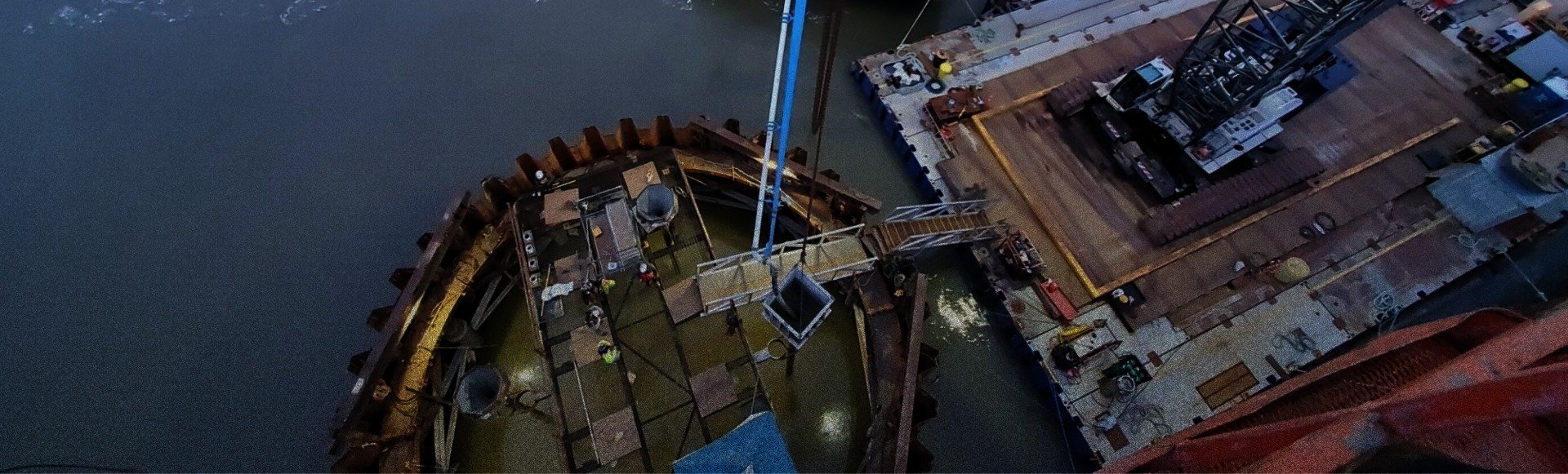
Annacis Island Wastewater Treatment Plant Outfall Project
Construction Management provided by Hatch
Metro Vancouver
|
Annacis Island, Delta, British Columbia, Canada
|
2018–2025
Social and economic impacts expanding capacity for 1M+ residents
First Nations engagement protecting rivers fisheries heritage sites
Wildlife protection using sonar surveys for sturgeon monitoring
Environmental controls with pH monitoring and cofferdam containment
Challenges
- Project was located in a high seismic zone, which posed significant risks of liquefaction and lateral spreading.
- Design and placement of two 130-meter-long diffuser pipes under 19 meters of water in the Fraser River.
- Construction involved multiple sequences of tunnel boring machine (TBM) assembly and removal, while maintaining the required face pressure and applying ground conditioners to minimize abrasion and ground loss in sandy soils that would otherwise exhibit flowing behavior without support.
- Throughout construction, teams had to manage 3.5 bars of ground water pressure (about 50.8 psi) to keep the tunnel from leaking.
- During a seismic event with a 2,475-year return period, lateral deformation near the riverbed at the river riser could reach up to 1.55 m.
Solutions
- The tunnel route was chosen to bypass liquefaction-prone soils, while the outfall diffuser manifold, situated in these soils, was built to withstand severe ground deformations.
- A custom configuration combined a slurry microtunnel TBM with an “extension kit” and cutterhead to achieve the required 5.0 m excavated diameter.
- Effluent tunnels were placed below liquefiable ground materials, and above-grade structures were pile-supported.
- The diffuser steel pipeline was designed to deform without damage.
- Special seismic steel pipe sections, inspired by Japan’s steel pipe for crossing faults (SPF) technology, were used to address large permanent ground deformation. This is North America’s first application of SPF technology for seismic challenges.
Highlights
- 5m diameter pressurized face Tunnel boring machine
- Slurry wall shafts with structural concrete liner
- Tunnelled connection to in-river diffuser manifold
- Marine construction of outfall riser and diffuser
- Extension of wastewater treatment plant level control structure
- Construction of an Emergency Influent Bypass Conduit
- Improved dilution ratio (20:1) promoting a sustainable future
- Named Canadian Project of the Year (under $300M CAD) by the Tunnelling Association of Canada
- Received the 2025 ACEC-BC award of Merit
“Planning and designing a project of this degree of complexity requires highly experience and dedicated experts which is what we saw in the design team... Complementing the design team, Hatch Ltd. and Jacobs Consultancy Canada rose to the challenges of successfully managing the construction of the project."
Project Numbers
Construction Cost: $300 Million
Project Duration: 7 years
Tunnel Diameter: 5.0 m
Diffuser Length: 130 m (x2 pipes)
Groundwater Pressure Managed: 3.5 bar (≈50.8 psi)
Population Served: 1M+ residents