New to Hatch, Umit brings 20 years of experience specializing in project management and controls in process plants, heavy infrastructure and mining, and civil and energy engineering. He holds a bachelor’s degree in civil engineering from the Bogazici University of Istanbul. Umit’s work includes contributions to more than 10 major projects across Canada including Jansen, Europe and the Middle East totaling $35 billion in value, from studies through execution and commissioning. Umit will succeed Bernard Livet, effective immediately.
Abdolmajid Erfani
Assistant Professor of Civil & Environmental Engineering, University of Washington
Abdolmajid (Mazi) Erfani is an Assistant Professor of Civil & Environmental Engineering at the University of Washington and Director of the Analytics for Infrastructure Management (AIM) Lab. His research applies artificial intelligence and data analytics to decision-making in construction, transportation, and infrastructure systems. He earned his PhD in civil engineering from the University of Maryland, College Park, in 2023.
Lise Bouchard
Regional Managing Director
Lise is an engineer with over 25 years of experience in management and project controls with most in project execution phase of multi-billion projects in mining, metals and infrastructure. Having worked oversees for over 15 years in different project phases and execution strategies including within a joint-venture environment, Lise brings that expertise to her role, keeping Hatch at the leading edge of technical and delivery excellence.
Farzaneh Golkhoo
Senior Principal, Risk Solutions
Farzaneh Golkhoo is a Senior Risk professional with more than a decade of experience supporting major infrastructure programs and projects. Holding a PhD in building engineering (construction management), Farzaneh specializes in integrated cost and schedule risk analysis (QCSRA/QSRA), Monte Carlo simulation, and project delivery risk assessment across EPCM, EPC, PDB, and Alliance models. With experience spanning feasibility, design, construction, and execution, Farzaneh has supported project portfolios exceeding $40 billion in value. Farzaneh helps organizations develop risk management frameworks, establish decision-grade contingencies, validate target prices, and improve schedule certainty. She also advises project leadership on risk exposure and strategic decision-making while delivering risk and project controls training to industry and academic audiences.
Loading component...
From hand-drawn timelines to complex project networks and today's cloud-based planning platforms, construction scheduling has evolved significantly over the decades. Yet despite major advances in computing and digital project controls, most projects still rely heavily on manual interpretation, static Critical Path Method (CPM) logic that determines the project completion date, and planner experience. As projects become larger and more complex, these traditional planning approaches are increasingly being pushed to their limits.
A baseline is developed at the beginning of each project, with the assumption that it represents the most efficient way to deliver the work. As execution progresses, the focus shifts to monitoring performance against that plan and taking corrective action when deviations occur. This process typically continues until the original baseline is no longer viable, at which point a revised plan is developed. Schedulers must continuously evaluate constraints, test alternatives, review updates, and coordinate decisions across highly dynamic project environments. As a result, construction scheduling remains one of the most knowledge-intensive and experience-driven functions in project delivery.
A schedule is a complex mathematical model, and continuously analyzing it requires significant intellectual effort. Yet the increasing complexity of projects, combined with the demand for faster delivery and greater predictability, is beginning to expose the limitations of current scheduling approaches. At the same time, the recent rise of generative AI, large language models (LLMs), graph-based learning, and agentic AI workflows are opening the door to a new generation of “schedule intelligence.” These approaches are capable of learning from historical projects, generating preliminary schedule structures, assisting planners in scenario exploration, and transforming schedules from static project documents into reusable organizational knowledge.
The construction industry is now entering the early stages of this transition.
The limitations of current scheduling workflows
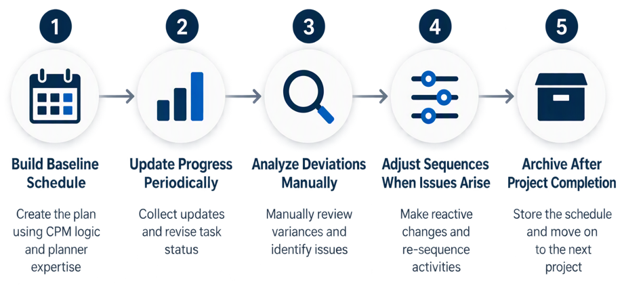
Despite advances in digital project controls, most scheduling workflows still follow a largely linear process, as depicted in Figure 1: build the baseline, periodically update progress, manually analyze deviations, revise sequences when issues arise, and ultimately archive the schedule once the project is completed. While this approach remains foundational to project delivery, it also creates several challenges. Schedule analysis is often manual and time-intensive, scenario exploration can be difficult to scale, and valuable execution knowledge from previous projects is rarely reused. In many cases, lessons learned remain fragmented across disconnected schedules, reports, and project records.
One limitation of current scheduling practices is the lack of reliable data for benchmarking and decision-making. Every major project is unique, with differences in technology, geography, timelines, and resources. Combined with the continued reliance on manual data collection methods, this limits the accuracy and reliability of planning efforts. As a result, teams often resort to simplification and expert judgment to manage complexity.
Figure 1. Traditional linear scheduling workflow
Perhaps most importantly, organizations accumulate thousands of historical schedules over time, yet very few workflows are designed to continuously learn from them. As a result, significant execution knowledge is often lost once projects are completed. This is where emerging AI-enabled scheduling approaches are beginning to shift the conversation.
AI is expanding beyond optimization
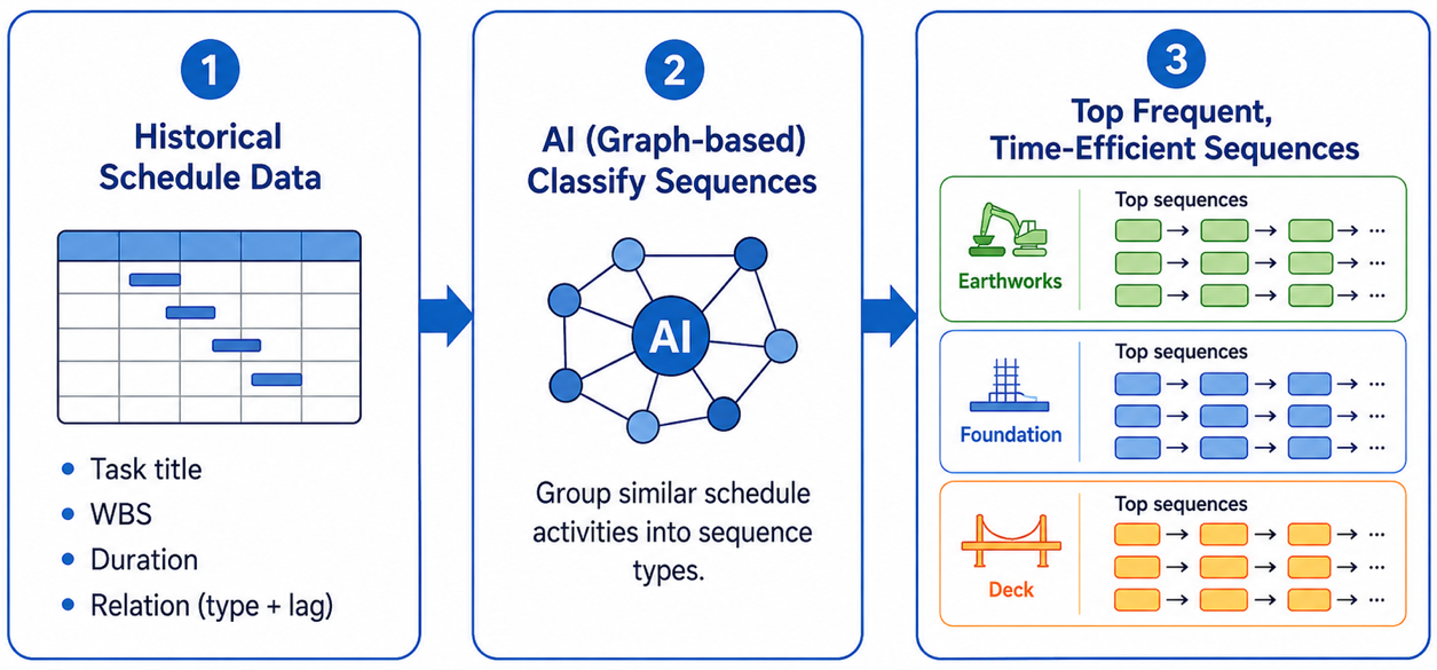
Much of the early momentum surrounding AI in construction scheduling has focused on optimization engines and automated scenario generation. Recent studies and emerging industry platforms have demonstrated how AI can evaluate large numbers of construction sequencing alternatives significantly faster than traditional manual planning workflows. Increased data processing capacity will help overcome the historical oversimplification of project schedules. As illustrated in Figure 2, graph-based AI approaches can transform historical schedules into reusable execution knowledge by identifying repeated execution patterns across projects.
Rather than replacing planners, these approaches augment decision making by automating repetitive schedule exploration and analysis tasks. AI-enabled scheduling platforms can support capabilities such as:
Exploring alternative activity sequences
Relaxing soft logic constraints while maintaining hard dependencies
Evaluating resource-loaded scheduling scenarios
Simulating alternative execution strategies
Comparing schedule durations and workload distributions across multiple planning options
Figure 2. Graph-based learning of historical construction sequences
AI is not simply calculating schedules faster; it is helping planners evaluate possibilities that may never have been explored manually. At the same time, another direction is emerging that may ultimately prove even more transformative.
The road ahead: The emergence of agentic AI workflows in scheduling
Beyond recent developments in graph-based schedule analysis, sequence learning, and AI-assisted forecasting, the reasoning and generative capabilities of modern AI models are enabling a new class of agentic AI workflows in construction scheduling. Unlike traditional single-model AI systems, agentic workflows can involve multiple specialized LLM-based agents collaboratively performing planning, reasoning, schedule generation, and scenario exploration tasks. These workflows introduce the potential for partial schedule automation while still maintaining human planners within the decision-making loop.
The future likely will not involve replacing schedulers. Instead, it will involve equipping planners with AI-assisted reasoning tools capable of processing far more information than traditional workflows allow. The industry is still in the early stages of this transition.
Many challenges remain:
Data quality and standardization
Schedule variability across projects
Integration with existing planning workflows
AI interpretability and governance
Human trust and adoption
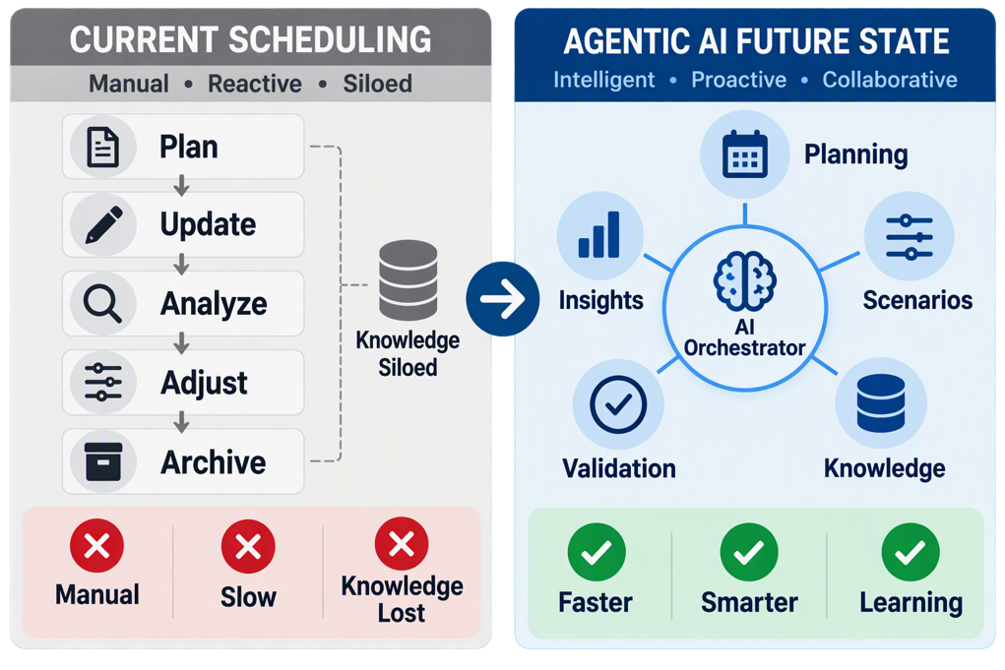
However, the trajectory is increasingly clear. Construction scheduling is approaching a fundamental shift in how planning knowledge is created, managed, and reused. The most significant shift may not be automation itself. Organizations already possess decades of project schedules and execution records, yet few processes are designed to learn from them systematically. AI creates an opportunity to transform those historical records into a source of knowledge that can help improve future planning decisions.
Figure 3. The emergence of AI-assisted schedule intelligence
Human expertise
Historical project intelligence
Graph-based knowledge structures
AI-assisted reasoning
This advancement will drive broader utilization of building information modeling tools and 4D/5D planning. The transition from static schedules to schedule intelligence has already begun.
References
Hong, Y., Xie, H., Hovhannisyan, V., & Brilakis, I. (2022). A graph-based approach for unpacking construction sequence analysis to evaluate schedules. Advanced Engineering Informatics, 52, 101625.
Zhang, Y., Li, X., Teng, Y., Shen, G. Q., & Bai, S. (2024). Unlocking Large Language Models for Project Scheduling. In ICCREM 2024 (pp. 562-571).
Schneider, M., Ferreira Barbosa, W. (2025). Turn Around on the Future of Construction: The Power of AI in Construction Planning and Scheduling. 2025 AACE® INTERNATIONAL TECHNICAL PAPER.
Our perspectives
More conversations about the world's biggest challenges