Practice Area Lead, Electrical, Equipment Technologies
Mohammad, PhD, P.Eng. provides technical direction in electrical power and advanced control technologies that address the needs of Hatch clients in the mining, energy, and infrastructure sectors. He has led the development and implementation of several innovative technology solutions, including the world’s first three-electrode furnace power demand stabilization system and HµGrid, the Hatch microgrid controller.
Our perspectives
More conversations about the world's biggest challenges
Artificial Intelligence (AI) is rapidly reshaping data center power demand. Facilities that once required only a few megawatts are now expected to draw tens or even hundreds of times more power. At this scale, data centers resemble large industrial loads—similar to electric arc furnaces—where power quality, reliability, and load variability must be actively managed.
This shift has important implications for developers facing grid constraints, increasing reliability requirements, and rapidly changing AI workloads. Microgrids offer a strategic infrastructure solution.
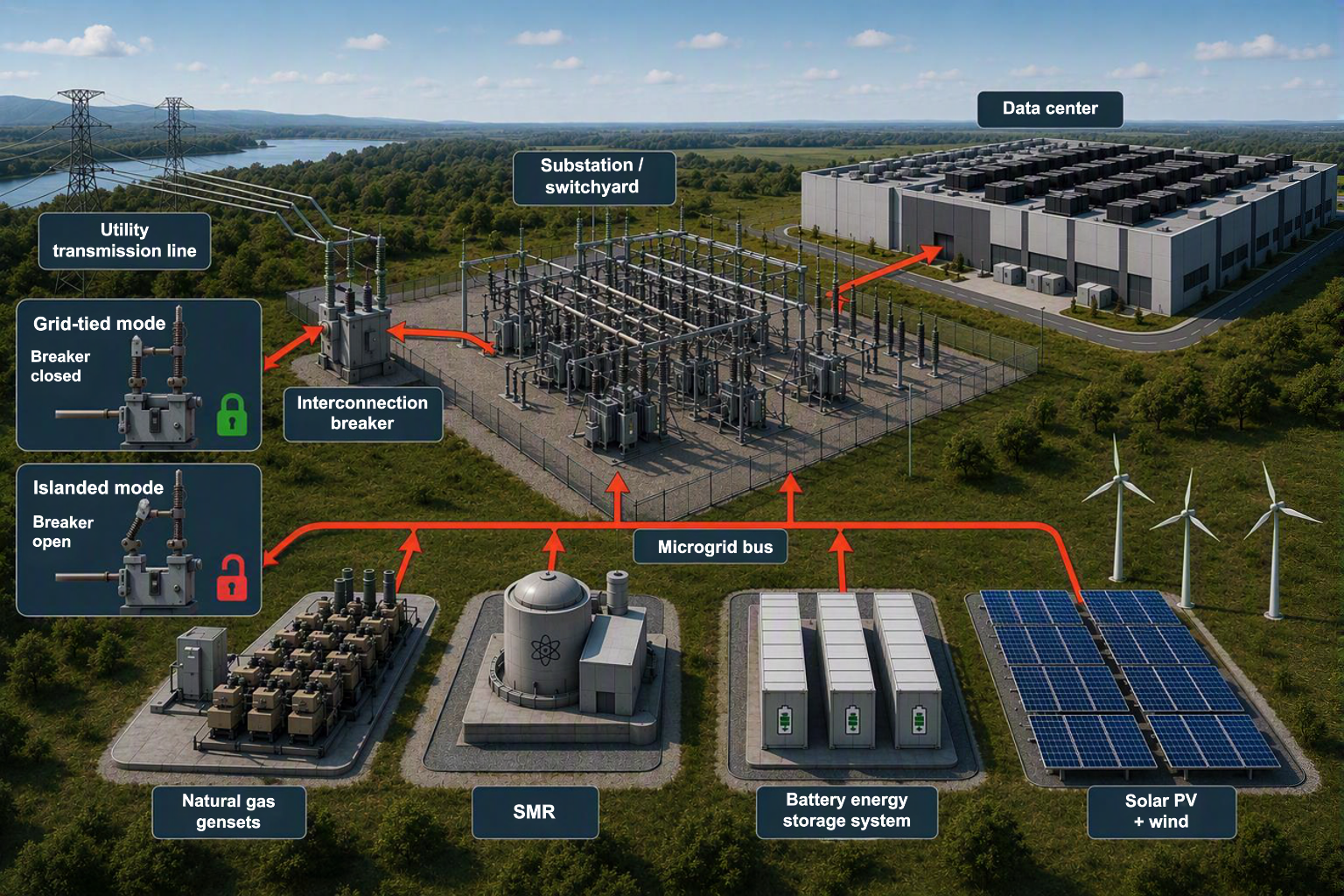
Caption: Powering a data center with a microgrid.
A data center microgrid combines on-site power generation and energy storage that can operate in parallel with the grid or independently in island mode. In this context, “microgrid” refers to the power supply configuration, not the size of the system.
The need for this flexibility stems from three challenges that increasingly shape AI data center power demand:
Grid capacity constraints that can delay or limit development
Power quality and uptime requirements for high-density computing loads
Rapid and unpredictable workload variability that can affect grid stability
Power availability is now shaping site selection
Securing access to power has become a defining constraint for data center development, directly affecting project viability and timelines.
According to BloombergNEF, data centers in the U.S. could account for about 20% of the country’s electricity consumption in 2035, up from 5.9% today [1]. This rapid growth is pushing developers away from historically dominant markets toward secondary regions with available grid capacity.
For projects facing delayed or constrained grid access, on-site generation within a microgrid offers an alternative. These systems can combine fossil fuel generation, renewables, battery energy storage, and small modular reactors. As grid power access improves, facilities can transition to hybrid systems that balance reliability, economic factors, and operational flexibility.
The quality of supplied power is especially critical for computational loads. Traditional data centers rely on utility power supported by Uninterruptible Power Supply (UPS) systems and back-up generators that are often fossil fuel based. While effective for maintaining uptime, this configuration can create broader system impacts during grid disturbances.
In 2024, the North American Electric Reliability Corporation (NERC) reported an event in Virginia in which a 1.5 GW load dropped from the grid within 82 seconds following a transmission line fault [3]. This kind of abrupt change in demand can threaten power system stability, which depends on the real-time balance between generation and consumption. Microgrids help mitigate these impacts by enabling on-site generation to operate continuously alongside the grid rather than functioning solely as emergency back-up. When adequately sized, they can also support island mode operation, allowing facilities to remain insulated from grid disturbances altogether.
AI workloads create a new load-management challenge
AI data center workloads create power demand profiles that are far more variable and less predictable than typical loads. AI workloads generally fall into two power profiles: training mode and inference mode (see Table 1).
Table 1: How AI training and inference create different power demand patterns
AI workload mode
What it means
Power demand pattern
Why it matters for the grid
Training
Building or improving the AI model using large computing clusters
High and sustained demand over long periods, with some short-duration fluctuations
Requires large blocks of reliable power and can create stability concerns when loads shift
Inference
Running the trained model to respond to user requests or generate outputs
More variable demand that rises and falls with usage
Creates less predictable load patterns, making power quality and grid planning harder
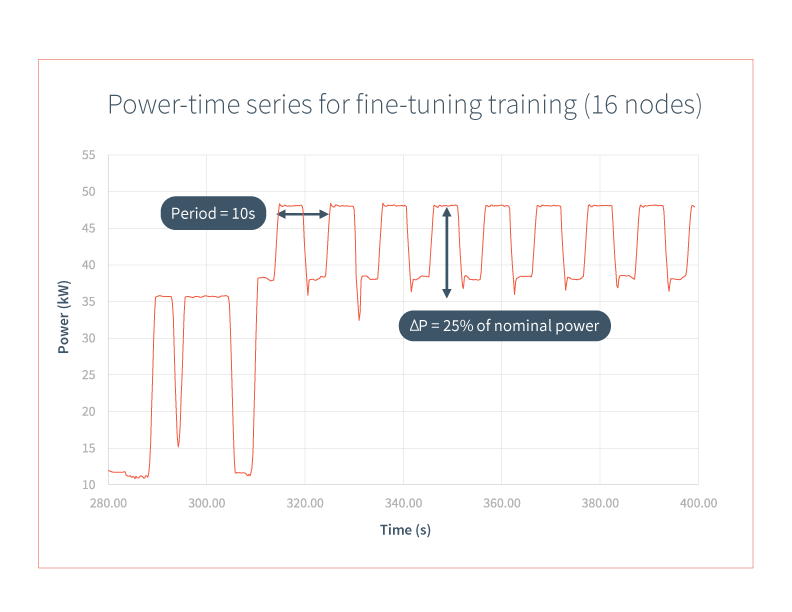
Beyond the broad demand patterns shown in Table 1, AI training workloads can also exhibit short-duration fluctuations (Figure 1) [4].
Figure 1: Power demand of a 16-node rack during training
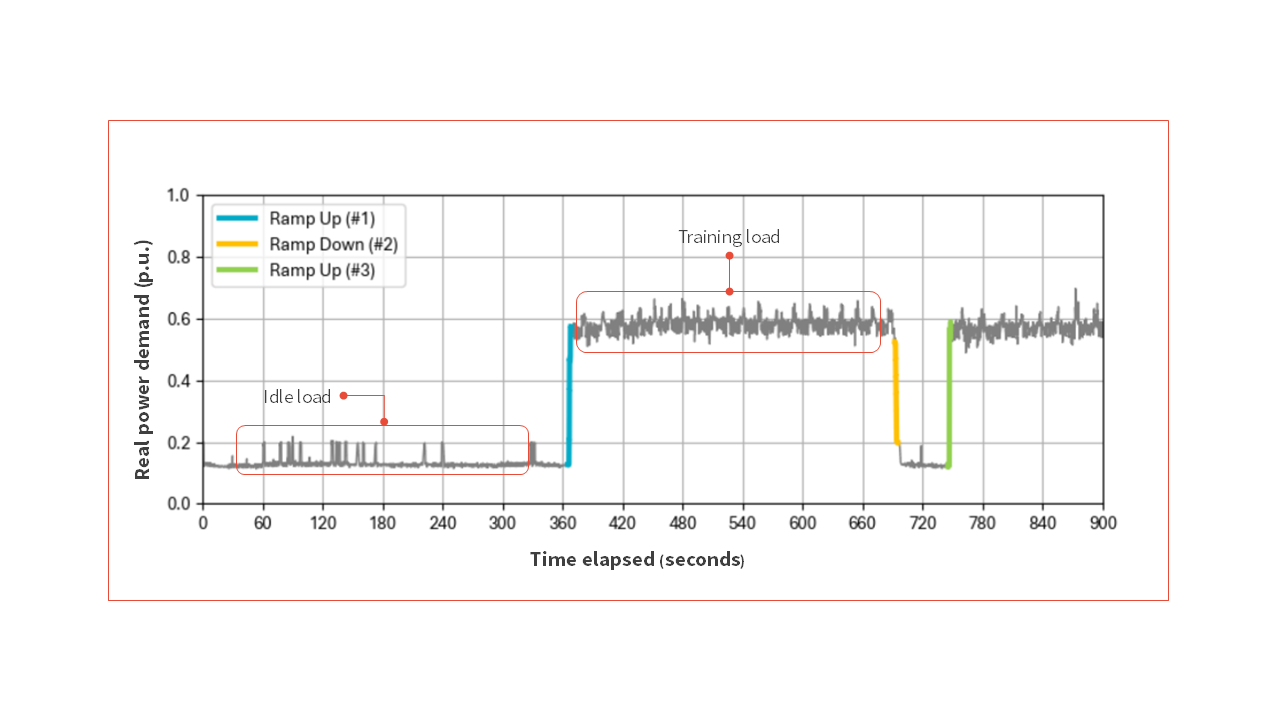
At the facility level, these load variations can translate into similarly large power fluctuations as shown in Figure 2. In a worst-case scenario, demand changes of up to 1.9 per-unit (95 MW) per second over approximately 250 milliseconds are observed during the ramp-up.
Figure 2: 50 MW block of a 200 MW AI Training Data Center Demand Profile [3]
Sizable load fluctuations resulting from large-scale AI training can create grid stability concerns in two ways:
Rapid shift in generation/demand balance, affecting power system frequency, complicating generation dispatch, and imposing greater reserve requirements.
Voltage fluctuations, flicker, and harmonic distortion, with the potential to affect other commonly coupled electricity customers.
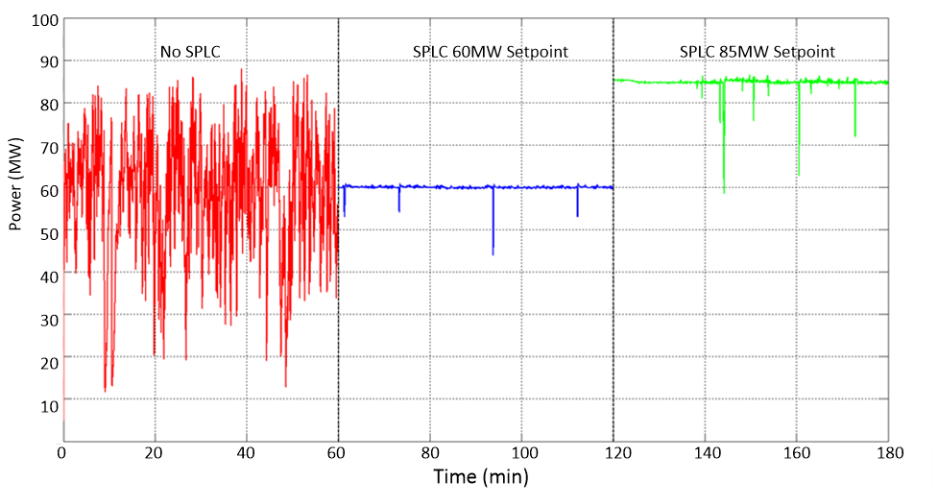
Similar load characteristics have long been associated with electric arc furnaces and other large metallurgical facilities. Some of these facilities have been operating as microgrids for power availability and reliability reasons. In addition, they often employ advanced power/voltage control systems, including Smart Predictive Line Controllers (SPLC), static watt compensators, static VAR compensators, synchronous condensers, or static synchronous compensators [5]. For example, Figure 3 illustrates how SPLC technology smooths power fluctuations in an electric smelting furnace, enabling stable operation within a ~100 MW microgrid. Similar technologies may have to be adopted to address the fluctuating loads of the AI data centers.
Figure 3: Power of an electric smelting furnace with and without SPLC for MW smoothing [6]
Microgrid configuration offers more freedom in handling the variability as fast response on-site generation can provide spinning reserve, while short-term duration energy storage or other power quality mitigation technologies can smooth the power profile presented to the grid and support the voltage and frequency.
Microgrids are becoming part of the development strategy
Power is becoming a defining factor in where data centers are built, how they’re designed, and which AI workloads they can support. The grid was engineered around predictable demand patterns. AI data centers behave differently. They are massive, geographically concentrated, and capable of rapid, significant swings in load. Microgrids and on-site power generation offer a practical way to address these challenges (see Table 2).
Table 2: How microgrids help manage AI data center power challenge
Power supply challenge
Grid-supplied AI data center
Microgrid powered data center
Grid capacity bottleneck
May require heavy utility infrastructure upgrade, delayed deployment
On-site generation can fast track development
Grid power quality
Needs adequately sized UPS and back-up generators
Can negatively impact grid stability when power is suddenly switched to back-up mode
Reduced impact on the grid due to use of on-site generation
AI workload variability
Needs compensation for MW and MVAR fluctuations
Reduced impact on the grid due to use of on-site generation, energy storage, power quality mitigation equipment, or a combination of all
Projects facing capacity constraints, long interconnection timelines, or highly variable workloads should treat on-site generation and microgrid solutions as a primary rather than supplemental approach to design.
Applying lessons from industrial power systems—where large, complex loads such as electric arc furnaces have long required active management—can help create more resilient and flexible data center power supply solutions. Hatch brings decades of experience designing power delivery systems for large, variable industrial loads. That perspective can help AI data center developers integrate site planning, power supply, reliability, microgrid design, and operational controls into one power strategy.
Developers that assess power strategy early will have more options, fewer schedule surprises, and greater control over reliability and operating performance.
[3] NERC Large Loads Task Force White Paper, Characteristics and Risks of Emerging Large Loads, July 2025
[4] Measurement of Generative AI Workload Power Profiles for Whole-Facility Data Center Infrastructure Planning, April 2026
[5] Advances in Power Quality Correction Technologies for Electric Arc and Smelting Furnaces, European Steel Technology and Application Days (ESTAD), Oct. 2025
[6] 90 MW 3 Electrode Furnace with an Electrically Islanded Power Plant Utilizing SPLC, SVC for Electrical Efficiency and Stable Operation in Shielded Arc and Immersed Arc Modes, 59th Annual Conference of Metallurgists, Oct. 2020