Worldwide, water resource recovery facilities (WRRFs) are facing growing pressure to meet increasingly stringent effluent regulations, improve operational efficiency, and address the rapid loss of experienced operators. Together, these challenges are creating an environment where WRRFs are expected to achieve higher levels of performance with fewer resources and reduced operational expertise.
Over the next decade, the industry is expected to experience a significant retirement wave, resulting in a substantial loss of institutional knowledge. At the same time, WRRFs are adopting more advanced treatment methods, including sidestream treatment technologies, advanced aeration control, and energy optimization initiatives.
These trends are outpacing the industry's ability to prepare operators effectively, creating a critical gap between rising operational complexity and traditional training methods.
As the industry undergoes this generational transition and facilities continue adopting more advanced treatment processes, utilities face the challenge of maintaining performance while transferring critical operational knowledge, improving efficiency, maintaining compliance, and supporting broader sustainability objectives.
In response, many WRRFs are exploring new approaches to operator training and operational support, with process simulation emerging as one of the most promising options.
Simulation has long been a trusted tool in the design of WRRFs, but its value for operations-focused training remains underutilized. Unlike traditional, passive training approaches such as slide-based presentations, classroom notes, and training manuals, simulators provide safe, consequence-free environments where operators can actively explore the effects of real-world scenarios such as wet-weather events, elevated loading conditions, energy or chemical optimization, and equipment outages on the performance of WRRFs.
By enabling experimentation and immediate feedback in otherwise slow-moving systems, simulators support deeper learning and stronger operational intuition. However, many traditional simulation tools were designed with engineers in mind, not operators.
As simulation technology continues to evolve, its role is expanding beyond engineering design. Utilities are increasingly exploring simulation for operator training, process optimization, scenario planning, and operational decision support. By allowing operators to test responses to changing conditions in a virtual environment, simulation can help build knowledge and confidence before decisions are implemented in the field.
Beyond training, simulation platforms can support a range of operational applications. When configured to a specific facility, they can be used for process analysis, control strategy evaluation, and future loading scenario modeling. Because simulations are both fast and risk-free, operators, plant engineers, and supervisors can use them to support planning, assess multiple options quickly, and make more informed decisions.
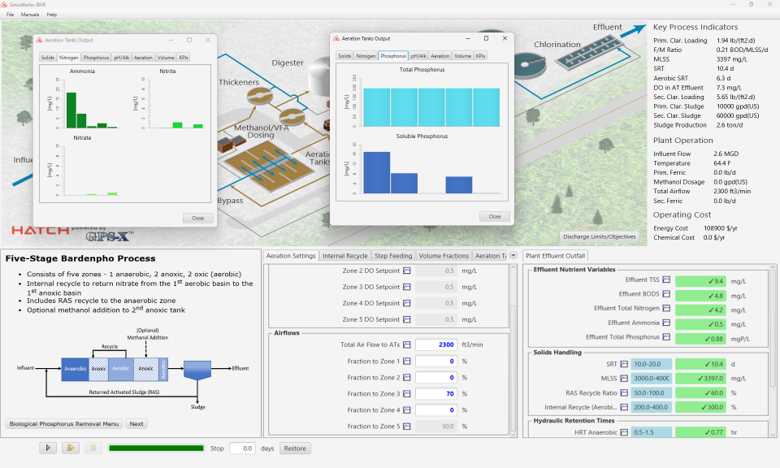
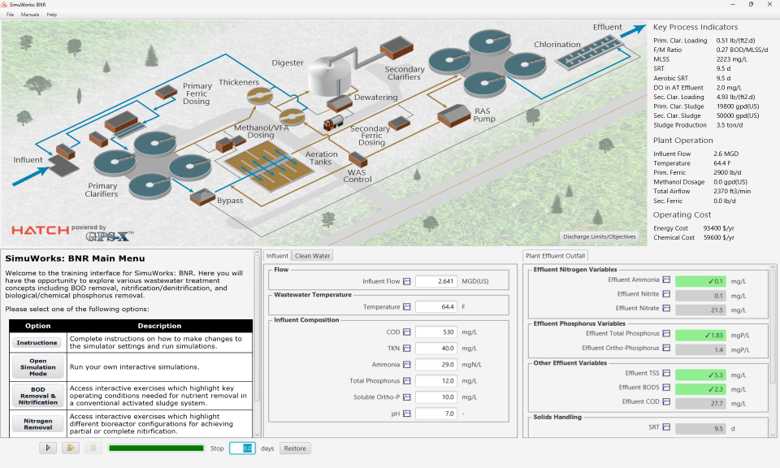
These capabilities are increasingly being incorporated into operator-focused simulation environments. One example is Hatch's SimuWorks™, which is designed to make advanced process modeling more accessible to operators while preserving the rigor needed for meaningful analysis. Powered by the GPS-X™ modeling platform, SimuWorks combines proven process simulation capabilities with a streamlined, user-friendly interface.
Using calibrated, plant-specific models, the system allows users to evaluate how operational decisions influence plant resilience, operating costs, and effluent compliance. By combining detailed process models with an operator-centric experience, SimuWorks closely reflects real-world plant behavior and enables more practical, hands-on learning. Operators can be tasked with correcting poor operating conditions, meeting stricter effluent limits, or adapting to temporary capacity constraints caused by maintenance activities. As facilities evolve, simulators can be updated accordingly, allowing operators to gain experience with new processes well in advance of implementation in the field.
Looking ahead, WRRF simulation technology is expected to become increasingly dynamic. Future systems may integrate real-time SCADA data to continuously update and auto-calibrate models. Combined with real-time weather forecasts and machine learning-based influent predictions, this will enable near-term performance forecasting and proactive operational planning. Automated risk assessment capabilities could further support decision making by evaluating alternative operating strategies based on defined objectives, such as reducing energy consumption, optimizing sludge handling, or improving wet-weather performance.
By integrating digital simulation tools into plant operations, utilities can extend the value of process models beyond design, thereby supporting operator training, improving day-to-day decision making, and laying the foundation for future digital twin implementations.
As the industry continues to navigate demographic shifts, regulatory pressure, and rising expectations for sustainability, investing in process-focused training is no longer optional; it's essential. Simulation provides a practical, scalable way to transfer knowledge, enhance decision making, and prepare the next generation of operators who will keep our water systems safe and resilient.
For utilities evaluating workforce transitions and increasing operational complexity, simulation is likely to play an increasingly important role in training, planning, and operational support.
Organizations are increasingly incorporating simulation into their long-term strategies to preserve institutional knowledge, accelerate operator development, and ensure consistent performance as wastewater treatment operations grow more complex.
To learn how simulation can support operator training, knowledge transfer, operational planning, and decision making at your facility, connect with Hatch to explore available approaches and solutions.