A successful seawater intake must withstand relentless wave forces, shifting sediments, corrosive environments, marine growth, and the long-term pressures of climate change. Structural strength alone is no longer enough. This is the frontier where material science, numerical modeling, and ecological considerations converge.
From Indigenous aquaculture systems in Australia to Roman fishponds and coastal baths, societies have long sought to harness the sea. But modern demands have reshaped the scale and urgency. The global desalination boom of the late 20th century and now the accelerating pressures of climate change have transformed seawater intakes into critical infrastructure.
These structures are the starting point for desalination plants, power generation cooling systems, and industrial processes that sustain entire regions.
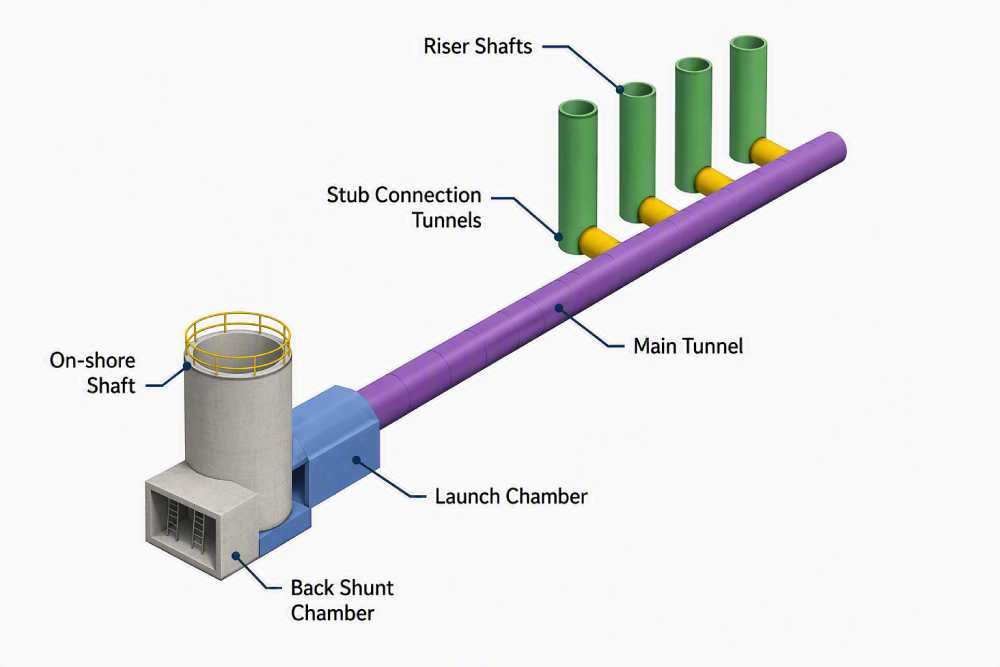
Figure 1
Example of an intake tunnel with multiple inlet structures
Source: Voutchkov, 2018
Today’s designs require a holistic, multidisciplinary approach that integrates hydraulics, oceanography, geological settings, and climate science. They must anticipate a dynamic marine environment while minimizing impacts on fragile marine ecosystems.
The dual mandate: Reliability and responsibility
Seawater intakes are designed with one overarching goal: to provide a consistent, high-quality flow of water while minimizing environmental harm. Achieving this balance requires navigating two key challenges:
Dynamic marine conditions. Intakes are subject to wave-induced cyclic loading, tidal variations, and scour. Design must account for extreme events such as 1-in-500-year storms alongside gradual forces of corrosion and sediment transport.
Environmental protection. Marine ecosystems are sensitive. Poorly designed intakes can entrain fish, disturb seabed habitats, or degrade water quality. Innovations such as velocity caps, passive wedge-wire screens, and subsurface infiltration galleries are helping reduce ecological impact.
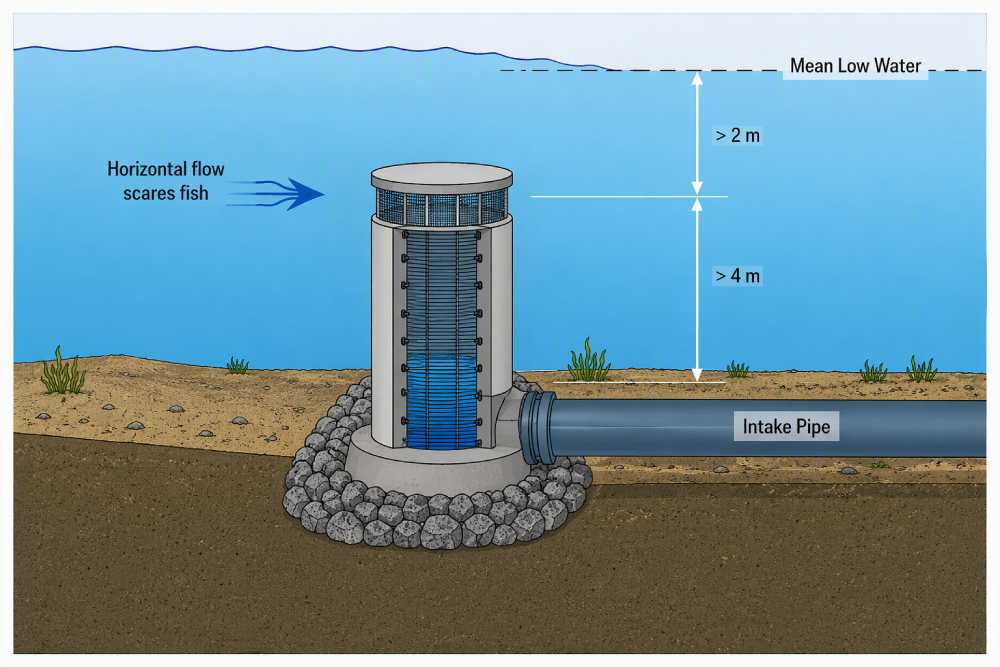
Figure 2
Velocity cap intake structure diagram
Source: Missimer and Maliva, 2018.
Predictions of sea level rise in Australia suggest an increase of up to 0.85 meters by 2090. Intake elevations, pump head design, and hydrostatic loading must all account for this reality.
Climate change is expected to increase the severity of many coastal hazards, including the intensity and consequences of severe weather. Marine and other in-water infrastructure should therefore consider future climate conditions, including higher environmental loading and more frequent extreme events, so structural integrity, serviceability, and durability requirements can be maintained throughout the asset’s design life.
Where historical design often relied on empirical formulas and limited datasets, modern practice combines these with advanced tools such as numerical modeling, phase-resolving simulations, and physical model testing to capture complex wave-structure interactions and account for uncertainty in future conditions.
Innovation at the water’s edge
Case studies show how the field is evolving. The Sydney Desalination Plant draws from 25-meter depths with carefully managed flow velocities to allow marine life to escape. Japan’s Fukuoka plant employs one of the world’s largest seabed infiltration galleries, relying on natural filtration to improve water quality. Emerging technologies such as biomimetic screens inspired by sharkskin, self-repairing epoxy coatings, and ultra-high-performance concrete are extending asset life and reducing maintenance costs.
The traditional view of seawater intakes has been as “pipes in the ocean,” but the reality is much more complex. A well-designed intake balances two equally critical objectives:
-
Resilient supply. Intake structures must reliably deliver high-quality water for decades while withstanding wave loading, seabed scour, tidal extremes, and long-term corrosion.
-
Responsible impact. Intakes must safeguard ecosystems, minimizing entrainment of marine life and avoiding degradation of sensitive seabed environments.
The evolution of seawater intakes reflects a broader trend in infrastructure: the convergence of digital tools, advanced materials, and ecological design. This includes innovations such as:
- Biomimetic screening systems that reduce biofouling and protect marine life.
- Self-repairing epoxy coatings and hybrid pile materials that lower maintenance costs and extend asset life.
- Hydrodynamic modeling (e.g., SWAN, SWASH, MIKE 21) that enables precision design for complex wave-structure interactions.
- Subsurface infiltration systems that leverage natural filtration for higher water quality and reduced treatment loads.
Our experience in action
For asset owners, the implications are clear: seawater intakes cannot be designed in isolation. They are the foundation of water security and must be considered as part of an integrated system, balancing resilience, operational reliability, and environmental responsibility.
At Hatch, we focus on a few key principles:
-
Early, holistic engagement: Understanding site-specific conditions from the outset reduces risk, cost, and complexity downstream.
-
Integrated expertise: Our teams bring together coastal, civil, structural, and environmental disciplines to deliver solutions that perform and protect.
-
Future-ready design: By incorporating climate change allowances, maintenance strategies, and long-term performance objectives, we create intake systems that endure.
The future of water security, whether for communities, industries, or power systems, begins at the intake. When seawater intakes are approached as integrated systems by bringing together expertise in hydraulics, coastal engineering, oceanography, geotechnical design, and materials science, every intake is optimized for both operational performance and environmental responsibility.
Learn more about how we’re partnering with clients to shape resilient, responsible infrastructure, and combining technical depth with multidisciplinary insight, to help design the future of water security.