In nuclear investment decisions, cost estimates often receive the most attention. Yet for lenders and governments alike, confidence in delivery can be equally crucial. As a new generation of nuclear technologies approach deployment, financial feasibility will depend less on first-project economics and more on the credibility of the deployment program that follows.
As jurisdictions pursue reliable, low-carbon electricity generation, nuclear power has become a central focus of long-term energy planning. Governments, utilities, and investors are evaluating a range of technologies, from conventional large-scale reactors to the latest generation of small modular reactors (SMRs). Traditional measures such as overnight capital cost (OCC), construction schedule, and levelized cost of electricity (LCOE) remain important, but they provide only a partial view.
For emerging nuclear technologies, long-term value will depend on deployment scale, technology maturity, and confidence in the program that follows the first project. As a result, nuclear economics should also be treated as program economics.
Why FOAK risk matters
The term first-of-a-kind (FOAK) is used to describe technologies that have not yet established a commercial delivery track record. The associated FOAK premium accordingly represents the added cost, risk, and uncertainty that can accompany early deployments.
This premium can extend beyond construction costs through schedule delays, higher contingencies, supply chain inefficiencies, regulatory requirements, and increased financing costs. A FOAK premium ultimately reflects the uncertainty regarding project execution and delivery performance. For investors and lenders alike, this uncertainty can often matter as much as expected cost.
For emerging technologies, this uncertainty is magnified because construction methods, supply chains, regulatory pathways, and operating performance are still being proven at commercial scale.
The promise and challenge of learning effects
One of the most cited advantages of SMRs is their potential to benefit from learning effects and scaled production. Studies published by Idaho National Laboratory (INL) suggest that repeated deployment of standardized reactor designs could drive meaningful reductions in construction costs through learning, supply chain maturation, and process optimization. INL analyses suggest SMR deployment programs could achieve capital cost reductions in the range of 8-9.5% per doubling of cumulative capacityi, although realized outcomes will ultimately depend on deployment scale, design standardization, and supply chain maturity.
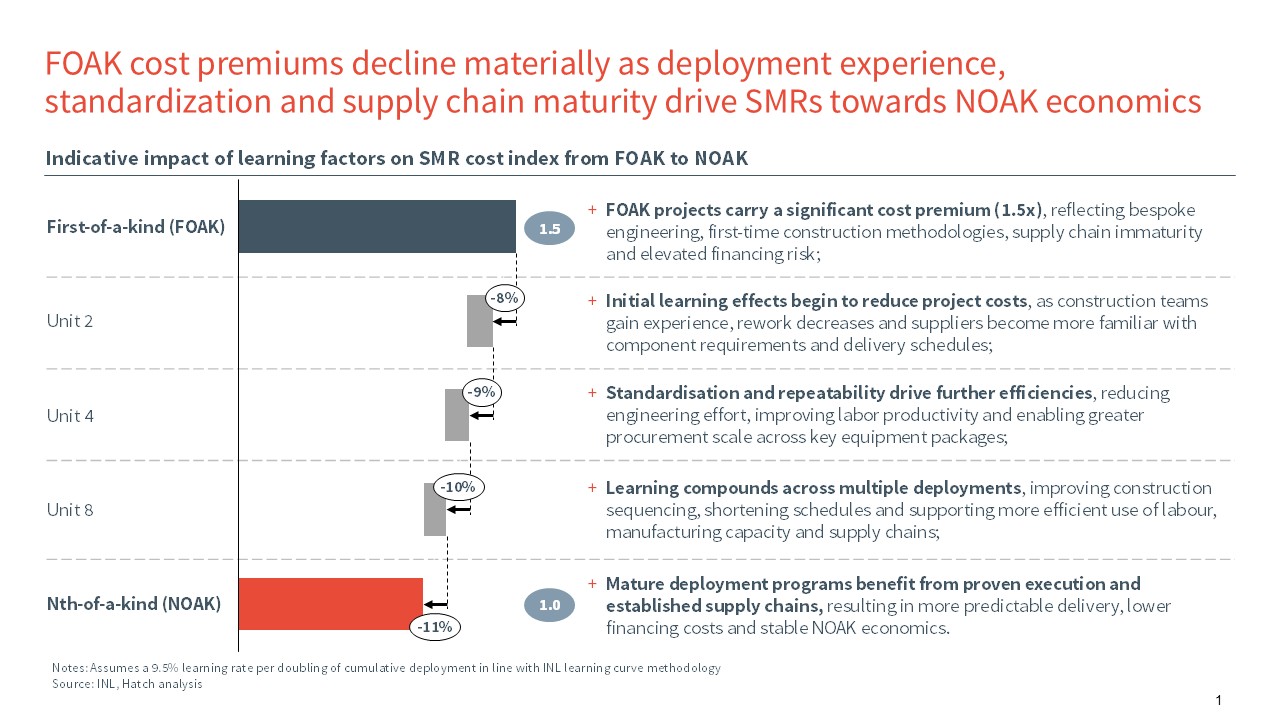
The most advanced global deployers of SMR technology are already well-progressed in defining and engineering component modularization, a critical component to delivering the benefits of at-scale production.
Importantly, the industry is not waiting for fleet deployment before addressing potential risks. Reactor vendors, utilities, and governments are already investing in design standardization, modular construction, factory fabrication, regulatory engagement, and program-level deployment strategies. Without those conditions, projected learning rates may remain theoretical rather than bankable.
Why investors and governments view FOAK risk differently
Commercial investors assess FOAK risk through the lens of risk-adjusted return. Schedule uncertainty, construction cost exposure, contingencies, and financing risk can all affect capital availability and terms. As a result, technologies with comparable expected costs may attract different financing conditions if delivery risk profiles materially diverge.
Governments often take the broader view, balancing project economics alongside energy security, emissions reduction, industrial development, workforce capability, and long-term competitiveness. This difference matters because governments may be willing to accept greater FOAK risk when it supports a credible future deployment pathway.
Nuclear economics are program economics
The economic proposition of emerging nuclear technologies extends beyond the performance of the first unit. Much of the anticipated value from SMRs relies on standardization, modular construction, supply chain maturation, and repeated deployment, benefits that can only be fully realized through a broader deployment program rather than a single project.
As a result, nuclear economics should be treated as deployment program economics. While exposed to a higher FOAK premium, the first project is accordingly a critical foundation for future learning, cost reduction, and industry capability development.
This has important implications for investors, utilities, and governments. Technologies with attractive projected economics may still struggle to secure capital if confidence in the long-term deployment pathway is limited. Conversely, programs supported by a clear project pipeline, committed stakeholders, and a credible route to repeatable deployment may be better positioned to capture learning benefits and improve financing conditions over the long term.
Looking beyond headline costs
Recent cost and schedule overruns on high-profile nuclear projects, including Vogtle Units 3 and 4 in the United States, have increased attention on delivery risk, cost certainty, and financing requirements. While new technologies could be comparable on a levelized-cost basis, technology maturity influences financing conditions, cost certainty, procurement strategies, schedule certainty, and the ability to replicate delivery outcomes across multiple projects.
However, construction outcomes alone do not determine lifetime value. Vogtle is now delivering approximately 2.2 GW of generating capacity, and early operating performance provides a more complete basis for assessing their long-term contribution alongside the cost and schedule overruns incurred during construction. As the first U.S. deployment of the AP1000 design, the project also carries characteristics of a first-of-a-kind build. Without repeated deployment, the premium paid to establish this capacity remains limited; in a program, however, it may become the foundation for more predictable delivery and lower costs across later units.
Stakeholders can actively influence FOAK risk through decisions relating to deployment sequencing, reference plant strategy, program scale, contracting approach, supply chain development, financing structure, and regulatory readiness. No single utility or jurisdiction may have sufficient demand to create the order book needed to reach nth-of-a-kind (NOAK) economics. Capturing these benefits may therefore require coordination across utilities, governments, regulators, vendors, and supply chain partners to aggregate demand, align deployment schedules, standardize requirements, and provide visibility over a multi-project pipeline.
Recent analysis comparing large-scale nuclear projects with an SMR fleet of equivalent generating capacity indicates that fleet deployment can create a different investment profile driven by:
- Earlier capacity coming online
- Staggered capital commitments
- Pathways for capturing learning factors and economies of scale
These factors can ultimately strengthen project returns, though the program must be structured to support repeatable delivery rather than isolated deployment.
What’s next
For investors, utilities, and governments, confidence in a technology’s ability to achieve sustained, scalable, and repeatable deployment may ultimately matter as much as its projected cost. The long-term economics of nuclear deployment will be shaped not only by individual project performance, but by the industry’s ability to transition from first deployments to repeatable programs.
In the next phase of nuclear investment, confidence in delivery may prove just as valuable as confidence in technology. Viewed through this lens, the economics of nuclear deployment extend beyond the performance of any individual project. The technologies most likely to succeed may not be those with the lowest first-unit cost, but rather those supported by credible pathways to repeatable deployment, sustained learning, and long-term value creation.
Sources: