Managing Director, Project Management and Construction Excellence
Lise is an engineer with over 25 years of experience in management and project controls with most in project execution phase of multi-billion projects in mining, metals and infrastructure. Having worked oversees for over 15 years in different project phases and execution strategies including within a joint-venture environment, Lise brings that expertise to her role, keeping Hatch at the leading edge of technical and delivery excellence.
Moe Roghabadi
Global Director, Risk Solutions
Moe Roghabadi is Global Director, Risk Solutions at Hatch, leading the development of best-in-class risk management capabilities. With over 15 years of research and field experience, he enables informed decision-making for large-scale projects across infrastructure, mining, and energy. His expertise spans delivery models including P3, EPCM, Alliance, and Progressive Design-Build. Moe is actively engaged in advancing industry practices, serving as a member of the AACE Decision & Risk Management Subcommittee, a technical body dedicated to evaluating, developing, and disseminating recommended practices related to decision analysis, and uncertainty modelling.
Ehab Elhosary
Risk Management Specialist
Ehab is a Risk Management Specialist at Hatch with a PhD and more than 8 years of experience in planning, project controls, and risk management across energy, petrochemical, real estate, and infrastructure projects. PMP-certified with expertise in AI-assisted HAZOP solutions to enhance efficiency, safety, and operational performance. With a background in engineering and project management, Ehab leverages data-driven insights to enhance risk management and support informed decision-making.
Our perspectives
More conversations about the world's biggest challenges
Smarter execution planning: The power of market intelligence
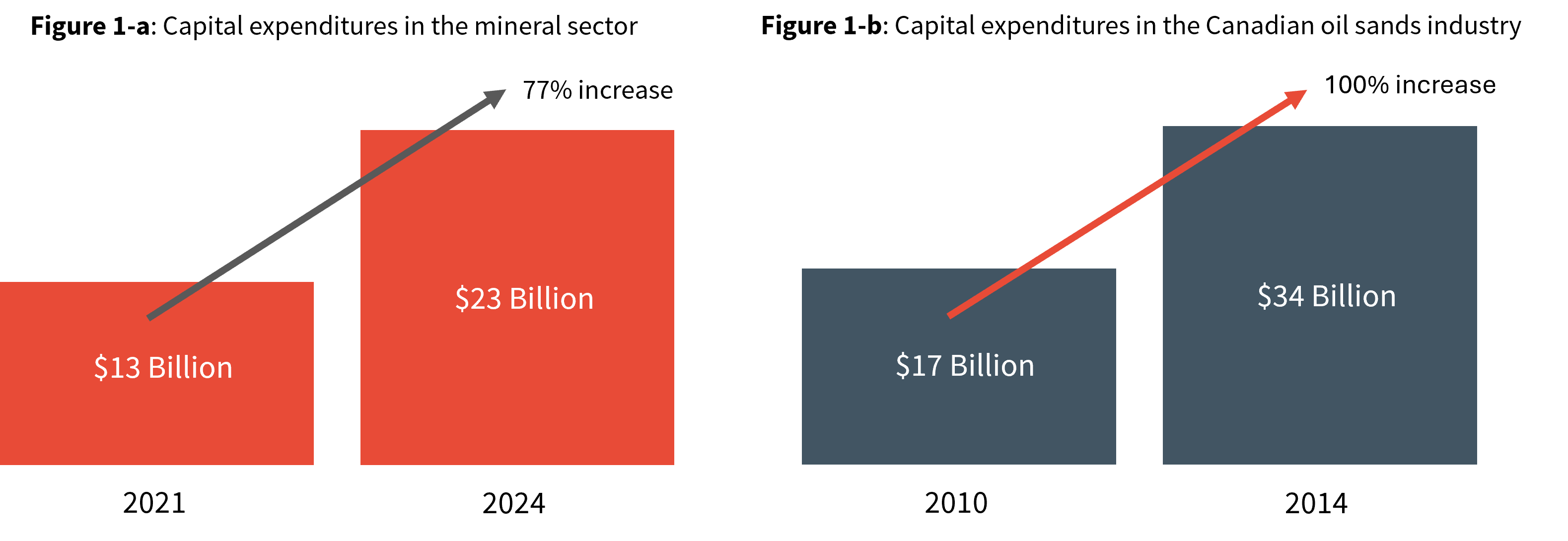
According to Natural Resources Canada, capital expenditures in the minerals sector increased by 77% between 2021 and 2024 (Figure 1-a).1 This raises an important question for mining organizations: how does such rapid investment growth impact project objectives, and what opportunities or risks does it introduce?
Answering this requires analyzing historical trends in the minerals sector and drawing insights from other industries that have experienced similar growth patterns.
Figure 1-b illustrates capital expenditures in Canada’s oil sands industry between 2010 and 2014. During these years, the sector experienced a comparable surge, with capital expenditure increasing by approximately 100%.2 This rapid escalation significantly disrupted labor markets and reduced execution efficiency for projects in construction during that period.
An empirical study by the Construction Owners Association of Alberta, analyzing 68 projects from 2006–2019, found that labor dynamics in oil sands projects were heavily impacted by this growth.3 The study demonstrated that during this period of time the indirect labor hours approached, and in some cases reached ~90% of direct hours, far exceeding planning assumptions. The primary driver was not contractor performance, but external market conditions and shifts that are often misunderstood or misattributed.
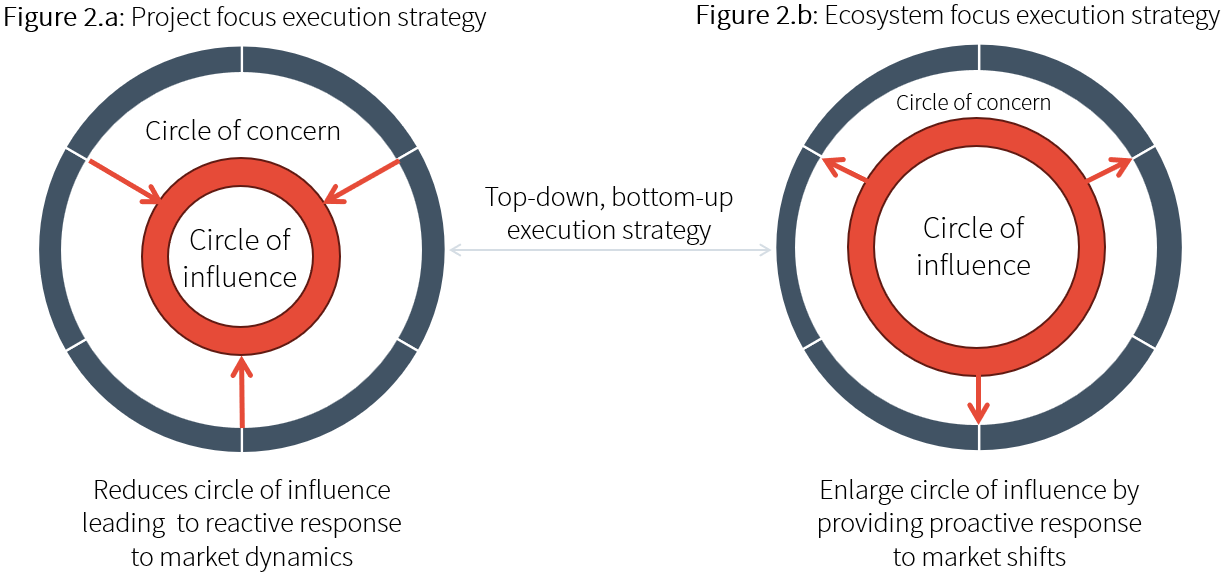
This example demonstrates that achieving cost certainty, predictability, and efficiency depends on embracing market intelligence and its real-time integration into performance measurement and project forecasting. This means that, unlike the conventional approach to execution planning which often focuses only on factors within the project team’s circle of influence and excludes the remaining areas within the circle of concern (Figure 2-a)—modern execution planning expands the circle of influence by incorporating market intelligence into the process (Figure 2-b).
In summary, this highlights the need to shift from a static, bottom-up execution planning approach to a more dynamic, top-down and bottom-up approach, where end users can, on a real-time basis, assess the impact of external threats and opportunities on project objectives.
A combined top down and bottom up execution strategy extends beyond traditional project boundaries. It requires innovative thinking at the organizational level, along with the adoption of new tools, systems, and processes enabled by emerging technologies. At the same time, it strengthens integration and expands the level of influence across the ecosystem. The next section discusses the key drivers that expand the circle of influence to enable project excellence.
A top-down, bottom-up execution strategy
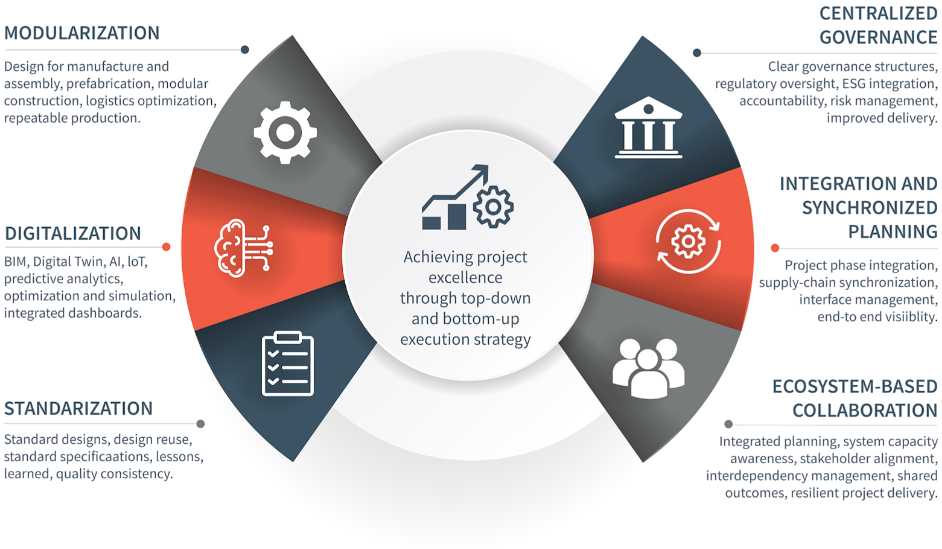
In practice, this approach is applied by improving areas within your organizations’ control while expanding the circle of influence within the ecosystem. It requires organizations to continuously transform external forces and business-market intelligence into effective execution strategies. As illustrated in figure 3, this approach combines top-down intelligence—derived from regulatory, market, and industry dynamics—with bottom-up execution through six complementary strategies: governance and regulatory alignment, integration, collaboration, standardization, digitalization, and modularization. Together, these strategies improve cost certainty, schedule predictability, productivity, and overall project performance.
Centralized governance
Establish clear governance structures, decision-making authority, regulatory compliance, and environmental, social, and governance (ESG) integration to strengthen accountability, manage risks, and improve project delivery. Effective governance ensures projects comply with regulatory requirements while addressing sustainability, ethical practices, stakeholder expectations, and long-term value creation. For example, Chinese megaprojects employ centralized governance through construction headquarters (CHQs), coordinated government oversight, integrated risk-sharing mechanisms, and incentive-based contracts, enabling faster decision-making, shorter schedules, lower costs, and improved project performance.4 Similar patterns can be observed in Canada and other North American jurisdictions, where government agencies and regulatory bodies are often closely involved in project governance and decision-making throughout both the engineering and construction phases.
Integration and synchronized planning
Connect engineering, procurement, and construction (EPC) phases, supply chains, and project information into a single coordinated execution model. Rather than managing each function independently, integrated delivery synchronizes planning, procurement, logistics, and execution to improve visibility and reduce fragmentation across the project lifecycle. Research shows that integrating procurement and supply-chain networks enables buyers and suppliers to synchronize their activities, resulting in faster delivery, improved procurement efficiency, and lower project costs. For example, Chinese engineering firms further strengthen integration through a single-contracting entity model, which combines EPC under one organization while closely integrating suppliers throughout the project. This integrated approach significantly shortens project duration and improves execution certainty compared with fragmented delivery models.5
Ecosystem-based collaboration
Canada is entering a period of unprecedented investment in mining, energy, and infrastructure. While this growth creates significant economic opportunities, it also raises an important question: Can the broader project delivery ecosystem support the pace of investment being planned?
Traditional project management focuses on optimizing performance at the project, program, and portfolio levels. However, systems thinking suggests that project success is determined not only by the performance of individual projects, but also by the capacity and resilience of the broader system in which they operate.
Systems-thinking literature highlights that system failures often occur not because individual components fail, but because the interactions between components become overloaded. In major projects, this can manifest as labor shortages, supply chain disruptions, permitting delays, transportation bottlenecks, and escalating competition for resources. While each project may appear viable in isolation, the collective demand placed on the ecosystem can reduce overall system performance.
Canada's transportation and logistics network provides a practical example. Major ports, rail corridors, and transportation hubs support the movement of equipment and materials required for mining, energy, and infrastructure projects. As investment activity increases across multiple sectors simultaneously, these shared assets face growing pressure. Without corresponding increases in system capacity, bottlenecks can emerge that affect multiple projects at the same time. This is where ecosystem-level thinking becomes critical. Rather than evaluating projects solely on their individual business cases, decision-makers should also assess the capacity of the broader system to absorb and support additional investment. A technically sound project can still experience delays or cost overruns if the surrounding ecosystem lacks the capacity to support its delivery.
To address this challenge, Canada needs an integrated project ecosystem in which owners, contractors, designers, suppliers, regulators, governments, Indigenous communities, and other stakeholders work toward shared objectives. By balancing investment decisions with system capacity and proactively managing interdependencies, organizations can improve resilience, reduce systemic risks, and increase the likelihood of successful project delivery.
Standardization
Leverage standardized designs, pre-approved equipment, and reusable specifications to shorten engineering cycles, reduce customization, and improve procurement efficiency. By incorporating lessons learned from previous projects, standardization promotes continuous improvement, increases repeatability, reduces variability, and enhances quality, productivity, and execution certainty.
Digitalization
Integrate BIM with other digital technologies from concept design through the detailed construction drawing stages and throughout the project life cycle to enable data-driven and predictive decision-making. Rather than using digital tools independently, organizations should connect engineering, construction, operations, and asset management through an integrated digital ecosystem. Ontario Power Generation (OPG) provides a strong example of this transformation. Through the implementation of AVEVA's digital platform, OPG integrated thousands of sensors, cloud-based monitoring systems, predictive analytics, and AI-enabled maintenance models across its nuclear and hydroelectric facilities. Within the first two years, OPG achieved approximately US$4 million in efficiency savings, established more than 1,200 predictive maintenance models, reduced annual maintenance activities by 3,000 hours, and shifted from reactive to condition-based maintenance.6
Modularization
Industrialize project delivery by shifting work from on-site construction to manufacturing environments through Design for Manufacture and Assembly (DFMA), prefabrication, off-site construction, and modular construction. These approaches reduce project complexity, improve quality, increase productivity, and enhance execution certainty. A recent study analyzing 11,011 projects across 23 project types found that modular projects—including solar power, wind power, electricity transmission, and pipelines—achieved significantly better cost performance than traditional bespoke projects. Modular projects experienced an average cost overrun of 12%, compared with 54% for non-modular projects, and were substantially less likely to experience extreme cost overruns (8.3% versus 18.7%). The study concludes that modularization improves predictability by reducing complexity, promoting repeatability, and enabling large-scale industrialized project delivery.7
Achieving excellence during execution is not just about reacting better, it is about planning smarter. By embedding market intelligence into strategy and combining top-down insight with bottom-up rigor, organizations can anticipate disruption, protect performance, and unlock greater value. As market conditions continue to evolve, Hatch works collaboratively with clients to better understand the factors shaping project outcomes and to identify opportunities to strengthen execution through informed, data-driven decision-making.
3 Construction Owners Association of Alberta (COAA), Alberta Report III: Major Projects Performance Assessment System – Project Performance, Engineering Productivity, Construction Productivity, May 2019, p. 44.
4 Luo, L., Yang, Y., Zheng, J. and Xie, J., 2022. Measuring project governance of mega infrastructure in China: a scale development study. Sustainability, 14(2), p.593.
5 Yang, Y.S., Kull, T.J., Nahm, A.Y. and Li, B., 2017. Attitudes toward supplier integration: the USA vs China. International Journal of Operations & Production Management, 37(8), pp.1094-1116.
7 Flyvbjerg, B., Budzier, A., & Christodoulou, M. (2026). Towards a theory of modular natives: Explaining superscaling, China's greatest innovation yet. https://doi.org/10.48550/arXiv.2606.15757
.jpg?h=200&iar=0&w=180)