Five signs your plant is ready for AI-assisted control
This is the second post in our series on turning AI ambition into real operational performance. Your plant is already signaling—are you listening? Many mining operations delay AI‑assisted control because waiting feels responsible. Wait for better sensors. Wait for cleaner data. Wait for tighter base control. Wait until the organization is “ready". Yet every day, the plant tells a different story.
In the first post, we argued that AI only matters when it improves a real operational decision, and that the starting point is knowing which decisions need to change. This post moves from principle to practice. Before you can improve those decisions, you need to know whether your plant is actually ready. Spoiler, it probably is.
Operators intervene to manage instability. Setpoints are adjusted to accommodate feed variability, competing objectives, and imperfect information. Performance peaks on some shifts and regresses on others. Not because the flowsheet lacks capability, but because decisions are made under pressure, with limited foresight and inconsistent experience.
These conditions translate directly into business impact: unrealized recovery, unstable throughput, and margin left on the table. Crucially, they are not signs of immaturity; they are signs of readiness. The real cost is not adopting AI assisted control too early. It is failing to recognize when the infrastructure is already asking for it.
The readiness myth: Why “not ready yet” feels sensible and is expensive
The belief that AI‑assisted control requires perfect conditions is widespread and costly. Most modern process plants already operate with dense instrumentation, established regulatory control and advanced process control (APC) layers, and a deep reservoir of operational experience. What is missing is rarely infrastructure. It is a mechanism to apply that intelligence consistently, continuously, and at speed.
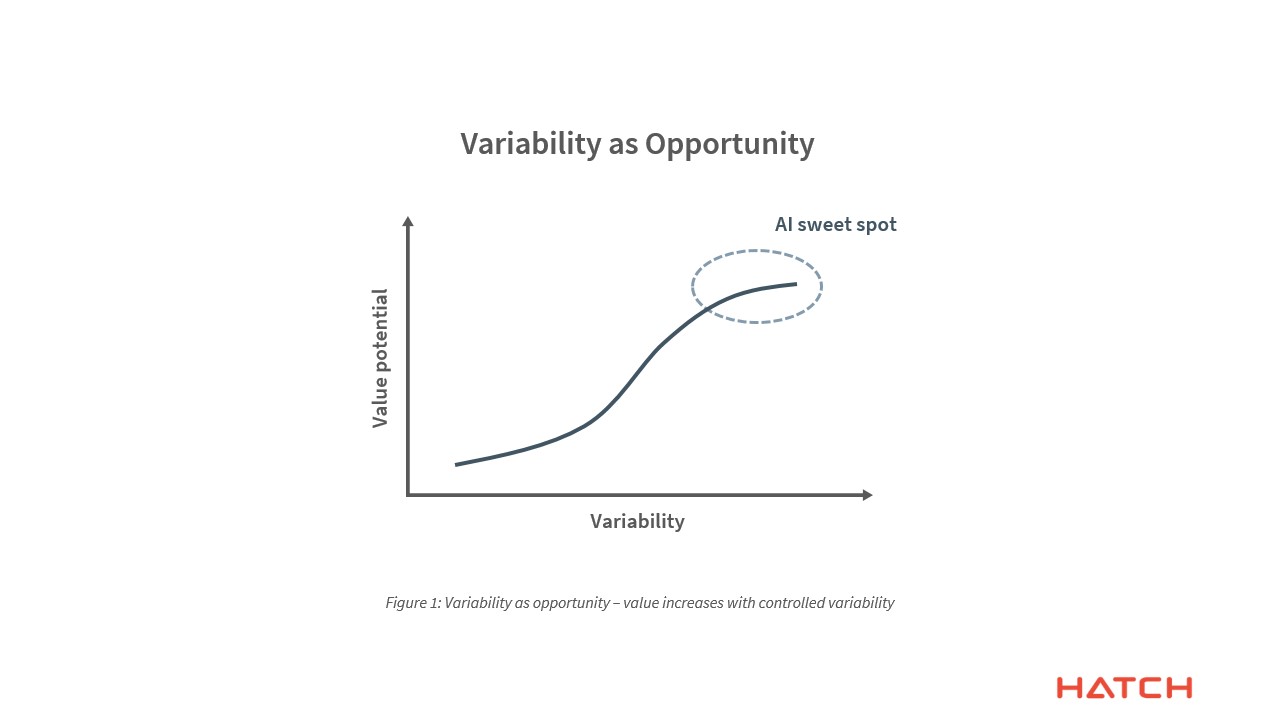
While organizations wait to become “ready,” variability accumulates. Recovery drifts with ore characteristics. Throughput and stability trade off unpredictably. Operator decisions remain difficult to standardize, scale, or sustain across shifts.
AI‑assisted control is designed to operate in this environment. It does not require simplicity or constancy; it extracts value from complexity by learning how the process responds to change and optimizes decisions accordingly. And as we noted in the first post, the cost isn't the model you didn't build, it's the better decisions you kept making the same old way.
Delaying adoption does not preserve value. It quietly erodes it.
What the plant already knows (and your systems don’t)
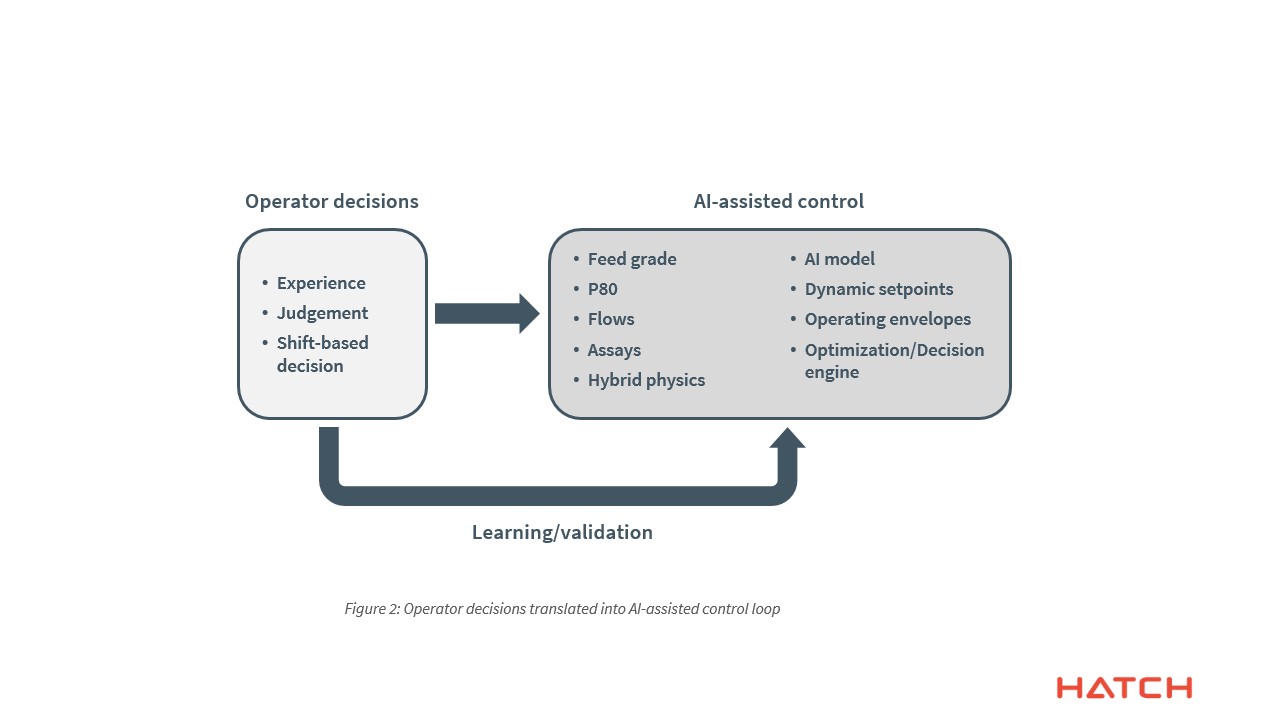
Every control room contains a powerful but fragile asset: operational intuition. Experienced operators regularly anticipate instability, adjust strategies for changing ore, and balance competing objectives in real time. These decisions work, but they are episodic, context-dependent, and difficult to transfer across shifts or sustain over time. AI‑assisted control does not replace this expertise. It codifies it and greatly expands it.
By learning how operators respond to changing conditions, validating those behaviors against historical outcomes, and applying them continuously at machine speed, AI‑assisted control transforms individual intuition into institutional capability. This is how hard‑earned experience becomes repeatable performance, regardless of who is on shift.
Five signs your process plant is ready
If your operation spends significant time responding to short‑term variability in recovery, stability, or throughput, you are already working in the right problem space. Variability usually reflects changing ore characteristics, interacting control variables, and decisions made without forward visibility. AI‑Assisted Process Control (AIPC), a solution developed by Hatch, addresses this by continuously evolving multivariate process models that explicitly learn how performance responds to intricate disturbances with the full set of manipulated variables. At MMG’s Dugald River operation, we implemented a closed‑loop flotation process twin that continuously forecasts grade‑recovery response and optimized control setpoints every five minutes, stabilizing performance without removing operational flexibility.
Modern plants no longer chase single targets. Operators balance recovery versus throughput, grade versus stability, and energy and reagent consumption against wear and risk. These are complex economic decisions, not simple control actions. AIPC formalizes these trade‑offs through explicit objective functions. Rather than optimizing one variable at a time, the optimization layer evaluates millions of feasible control combinations against recovery, grade, and economic outcomes. At Dugald River, this approach allowed the suite of underlying deep learning models to work toward a flowsheet-level, dynamic net smelter return objective; something no local rule-based controller could achieve reliably.
Frequent manual interventions are often misinterpreted as control system failure. In practice, they typically reflect responsive operators adapting to rapidly changing conditions when static control rules are insufficient. Our AIPC learns from this specific behavior. By analyzing historical operator’s actions and outcomes, it derives dynamic operating envelopes that shift with feed, grind size, and upstream conditions. The resulting control actions mirror good operator behavior, and are executed consistently, transparently, and without fatigue. This effectively digitizes the best operator behavior and delivers outcomes consistently, while also leaving space to learn from measured outcomes, and then making high-velocity incremental adjustments to find optimal. It’s impossible for a human to manage many variables at such a detailed level, and certainly not at high frequency and repetition.
When metallurgical performance varies noticeably across crews or individuals, it indicates that decision quality, not equipment capability, is limiting outcomes. The flowsheet can perform better, but only when the right experience is present at the right time. AIPC reduces this dependence by embedding validated decision patterns directly into the control layer. This shifts operators from continuous manual tuning toward supervisory oversight, ensuring consistent performance across shifts while retaining human authority and override. The aim is not to take away human insight, but to give operators the capacity to focus on targeted enhancements while AIPC handles the base load of control decisions.
Plant infrastructure, like concentrators, already operate layered control architectures combining regulatory control, supervisory control, and traditional APC. As ore variability increases and circuit interactions deepen, these systems are often pushed beyond their original design intent. AI‑assisted control extends rather than replaces this infrastructure. It operates above existing controllers, dynamically adjusting setpoints in accordance with wider area process trade-offs, not local isolated targets. Our approach integrates directly with plant control systems, increasing APC utilization and effectiveness rather than displacing proven control strategies. The default deployment option is a closed-loop approach that fully integrates powerful continuous learning AI into the control layer. For flexibility however, it may also be run as an integrated open loop system, which may be warranted in certain process plants or pilot applications.
Discover how our AIPC supports operators and improves performance with a new layer of transparent, adaptive process control here: Commissioning a Process Twin for Setpoint Decision Automation at Dugald River Mine.
Readiness reframed: From perfect conditions to actionable conditions
Readiness for AI‑assisted control does not require perfect instrumentation or autonomous operation from day one. It requires measurable variability, observable control relationships, operational teams already managing complexity, and a willingness to validate value before scaling. Most plants meet these criteria long before they realize it.
Moving forward with confidence: How Hatch delivers AI-Assisted Process Control
We deliver AIPC through a phased, risk-managed model designed to prove value early and sustain it over time. A feasibility phase establishes operational readiness, validates control relationships, and quantifies potential uplift. Implementation integrates hybrid process twins with existing control systems, moving past vague advisory dashboards to closed‑loop control. Beyond system deployment, ongoing client care ensures model life cycle management, continuous improvement, and sustained adoption.
The objective is not technology deployment for its own sake, but consistent, defensible improvement in operational performance.
Listening to what the plant is already telling you
Your process plant doesn’t become ready for AIPC overnight. It becomes ready quietly, through variability, operator behavior, and the limits of existing control systems. The question is no longer whether the signals exist; it’s whether we’re prepared to act on them.
Coming next in the series
So your plant is ready, but it's also huge. Where do you actually start? In the next post, we'll share a simple framework for pinpointing the highest-ROI, lowest-risk areas to begin with, so you can answer the questions every team wrestles with: How do we achieve focus? What's the right plant area? Do we chase maximum value or maximum ease? The short version: don't try to blanket the whole plant with AI on your first project. Start where it counts.
Where to start?
If even one of these signals looks familiar, your plant may already be positioned to capture value from AI-Assisted Process Control. A targeted readiness review can help identify where advisory/open‑loop, or closed‑loop control can deliver the fastest, lowest‑risk impact. Before variability erodes it further.
About the author

Johan Louw
Principal Consultant, Digital (AIM)
Johan is a principal consultant and business development executive at Hatch, where he leads our Digital practice’s Africa mining and energy strategy. With nearly 30 years of global experience across mining, energy, and manufacturing, he has held senior executive roles spanning process engineering, operations, and business development. He specializes in digital solutions for mining and mineral processing, with a focus on AI, and is recognized as a thought leader in turning complex technical challenges into commercial value, improving productivity, safety, and ESG outcomes across the mining value chain.

Warwick Smith
Global Practice Lead
Warwick has 18+ years in minerals processing and smelting operations, and consulting. His unique background spans site operations management of large-scale plants, site engineering roles, remote excellence center management, advanced process analytics for plant and decision automation, digital twin design and development. He is one of Australia's leading practitioners in the application of AI/ML to minerals processing and smelting.