The unfortunate reality is that severe weather extremes, including wildfires, floods, storms, and rising sea levels, are increasingly common and threaten our communities and industries. With nearly 10% of the world relying on electricity generated by nuclear power, and electricity demand projected to rise by more than 50% between 2022 and 2040, the need for climate-resilient infrastructure is more urgent than ever.
While nuclear facilities are designed with resilience in mind, utilities, support buildings, and other critical infrastructure must now be designed to meet government net-zero targets while anticipating and adapting to future climate risks.
Historically, many infrastructure projects evaluated emissions reduction and climate resilience separately. Today, organizations must address both simultaneously to help ensure assets remain operational, compliant, and cost-effective throughout their service life.
Tackling this challenge requires a targeted strategy, the right tools, and a dual adaptation and mitigation approach to address the risks of future weather events (adaptation) while also minimizing the impact on future ability to operate (mitigation).
Enabling climate-resilient design
While this approach can be applied to numerous industries, nuclear facilities face unique and heightened challenges; strict regulatory frameworks can limit the implementation of certain sustainable solutions. Nonetheless, climate-resilient design is critical to safeguarding the long-term reliability and safety of nuclear infrastructure in the face of a changing climate. By integrating mitigation and adaptation strategies early in the design process, stakeholders can reduce emissions, lower operational costs, and build infrastructure that withstand future climate risks.
Adaptation
The adaptation process employs a risk management approach to anticipate, prevent, withstand, and respond to climate change-related disruptions or impacts. It includes a multistep climate change risk assessment (CCRA) that evaluates the potential risks that climate changes poses to a project.
The procedure for conducting a CCRA is governed by the ISO 31000 Risk Assessment Process, and includes five steps:
- Establishing context: Characterizing the baseline and future climate to set the context for the assessment
- Risk identification: Identifying interactions between climate hazards and the project
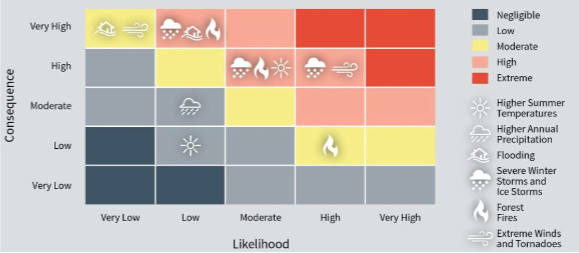
- Risk analysis: Assigning likelihood and severity ratings to each risk
- Risk evaluation: Evaluating the risks by multiplying the likelihood by the severity
- Risk treatment: Identifying and implementing adaptation and resilience measures within the design
Specific risk ratings may vary depending on what framework is being used, such as the Canada Climate Lens, Public Infrastructure Engineering Vulnerability Committee (PIEVC), or similar approaches. These ratings can be quantitative (e.g., a scale from 0 to 7, as in PIEVC) or qualitative (e.g., low, medium, high, or extreme).
Action is taken based on the risk ratings: low risks do not require mitigation but should be monitored; moderate risks require non-urgent measures, and high risks necessitate early or immediate adaptation.
Actions could include adaptation measures such as:
- Integration of a vegetative/cool roof to reduce demand for cooling due to higher summer temperatures
- Positioning of the building elevations to reduce risk of flood damage due to increased precipitation
- Restoration of local wetlands to reduce risk of damage due to forest fires
Mitigation
Mitigation refers to reducing greenhouse gas (GHG) emissions to prevent further adverse environmental impact. Broadly speaking, there are two ways of categorizing GHG emissions associated with infrastructure, including nuclear facilities: operational carbon emissions and embodied carbon emissions.
Operational carbon emissions include those produced from energy used during a building’s lifetime (e.g., heating, cooling, equipment). They are evaluated using an energy model (EM), which uses a baseline building design to identify alternatives to improve energy efficiency and reduce operational carbon. Some examples of effective modifications include:
- Infrastructure orientation: Locating buildings to minimize energy consumption and optimize ventilation
- Quantity and size of the windows: Energy efficiency while also maximizing natural light
- Thermal performance: Ability of a building’s envelope to reduce heating and cooling consumption and air leakage to promote energy efficiency
- Heating and cooling methods: Choosing efficient energy sources (e.g., geothermal versus natural gas)
- Usage: How the building occupants and activities affect energy consumption
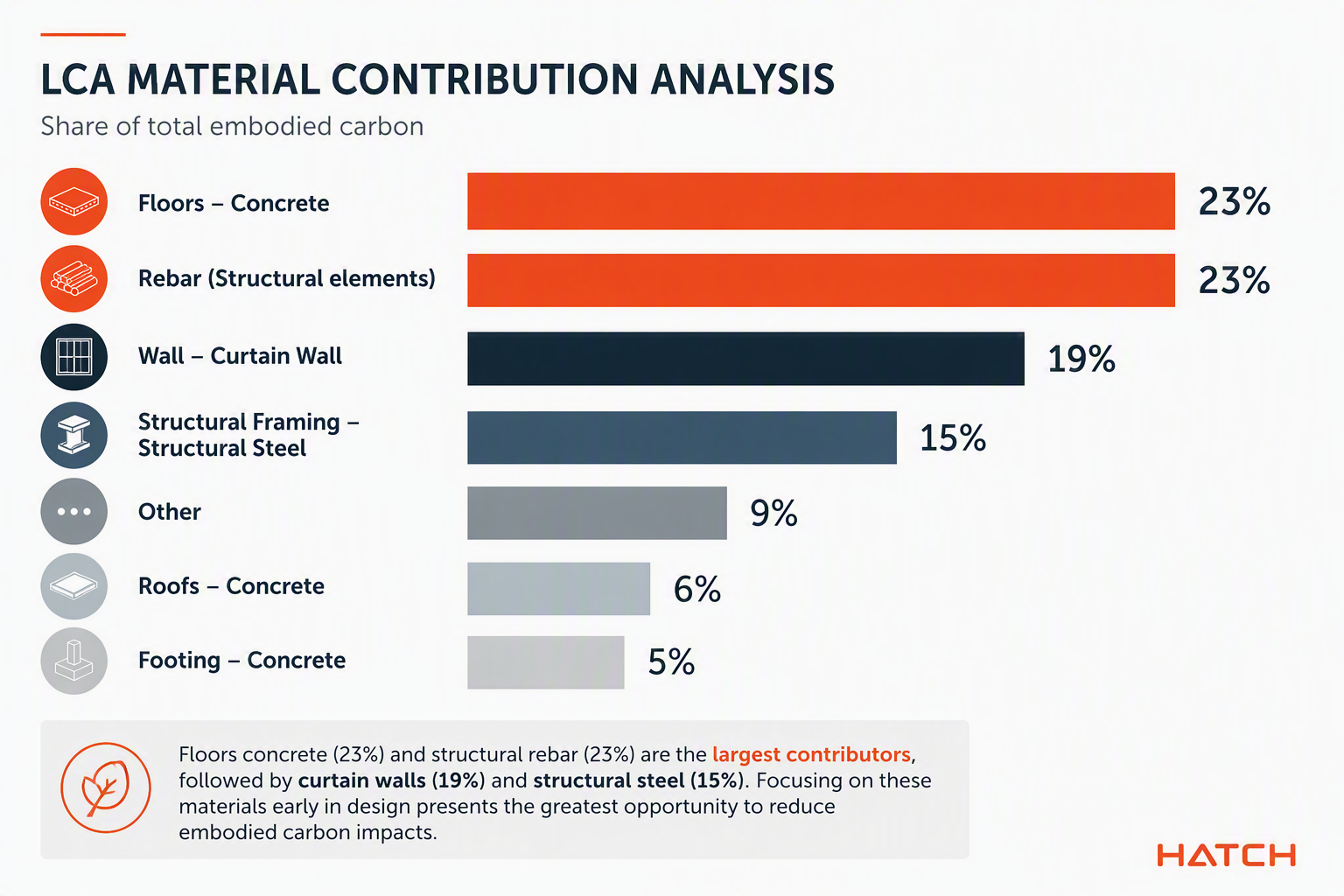
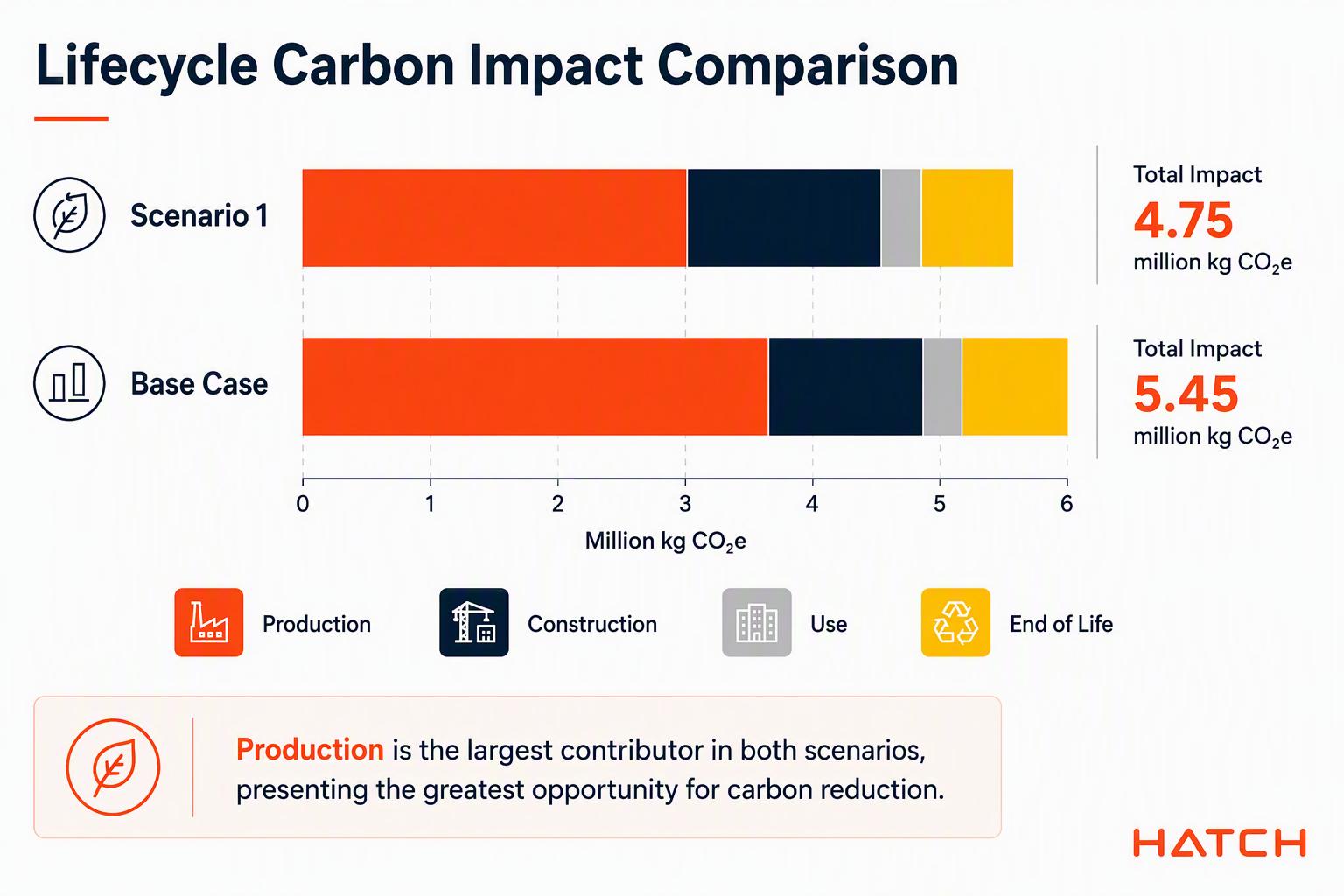
Embodied carbon emissions include those from materials and construction processes (e.g., manufacturing, transportation, installation, maintenance, and end-of-life disposal). They are measured by conducting a four-phased life cycle assessment (LCA) based on ISO 14044:
- Goal and scope definition phase: Defines and describes the product system to be studied and the context in which the assessment is to be made. Also identifies the boundaries and environmental effects to be reviewed for the assessment.
- Inventory analysis phase: Identifies and quantifies the inputs and outputs for a product throughout its life cycle.
- Impact assessment phase: Assesses the magnitude and significance of the potential environmental impacts for a product system throughout its life cycle.
- Interpretation phase: The results of the inventory analysis, and the impact assessment are considered together, and conclusions and recommendations are made. It is often an iterative process in which the scope of the LCA and the quality and coverage of the data is interrogated to ensure completeness and accuracy.
The EM and LCA are both informed by a baseline building design, which is then compared with the development of several alternatives to evaluate construction materials and energy efficiency measures. The results of the EM and LCA are used to refine the design, optimize building material selection, and improve building systems. The revised building design is then used to estimate the total costs and emissions over the facility’s operational lifespan.
Ultimately, the EM and LCA may create recommendations for design specifications such as exterior siding materials, more limited in nuclear applications due to additional code requirements when compared to other industrial applications, which necessitates maximizing the available measures. A good example of this is the use of mass timber structures to reduce the GHG emissions compared to steel, which may be a solution for an office building at a nuclear site, but not for a facility handling nuclear materials.
As climate risks continue to evolve, resilience and sustainability can no longer be treated as separate design objectives. For nuclear facilities and their supporting infrastructure, integrating adaptation and mitigation strategies early in the planning and design process is essential to ensuring long-term safety, reliability, and performance.
Partnering with Hatch provides access to the technical expertise, assessment tools, and practical experience needed to develop infrastructure that is safe, resilient, and built for the future.
Contact us to learn how we can help.