When the ground pushes back, contract strategy controls the outcome
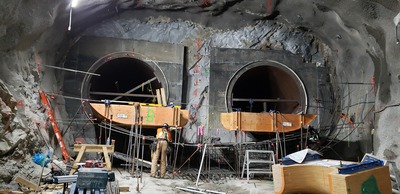
With geotechnical surprises as part of the process, successful projects depend on how contracts allocate risk and enable teams to respond when the ground behaves differently than expected or assumed.
We were eager to know how different types of contract models affected outcomes. So, we analyzed three major underground projects that had encountered significant, unforeseen geotechnical conditions and had outcomes that varied widely. Each was delivered under a different contract model: design–bid–build (DBB), design–build (DB), and engineering–procurement–construction (EPC).
From this, the determining factor on whether a project succeeded or struggled was not only site investigation—it was contract structure.
Across all three projects, owners invested heavily in thousands of meters of drilling, detailed geophysical surveys, and multiyear programs supported by experienced geotechnical teams. Despite this effort, each project encountered a major unexpected condition: a buried valley, a large karst cavity, or the potential intersection of an active fault zone.
These outcomes reinforce a fundamental reality of underground construction: the ground can only ever be partially known. No investigation program can eliminate uncertainty entirely. And owners who plan on site investigation data verbatim often pay the price later.
Choosing the right contract model to better manage uncertainty and risk
By comparing how each contract model handled geotechnical uncertainty in practice, the study reveals a consistent pattern: project performance is driven more by risk allocation and contractual mechanisms than by investigation intensity.
In the DBB project, the owner retained geotechnical risk and compensated for work using unit rates. When a large karst cavity appeared, responsibilities were clear. The contractor focused on mitigation, not claims. A multidisciplinary team developed a solution quickly, and the issue was resolved with limited cost and schedule impact.
But in projects where geotechnical risk was heavily transferred to contractors—particularly under EPC and certain DB arrangements—unexpected conditions triggered lengthy negotiations, cost escalation, and delayed decision making. Contractors, forced to price uncertainty they could not fully control, added substantial risk premiums at bid stage and became defensive when conditions differed from baseline assumptions.
In one case, resolving responsibility for a single buried valley took nearly three years under an EPC contract, despite the presence of a detailed geotechnical baseline report (GBR). Our study shows that while the GBR is an essential tool that provides clarity on expected conditions, it cannot eliminate uncertainty or shift geotechnical risk away from the owner. Treating it as a risk‑transfer tool creates false confidence and future conflict.
Owners often see fixed‑price DB or EPC contracts as a way to manage risk. But in underground work, this approach can produce the opposite effect. Our study shows that aggressive geotechnical risk transfer led to higher overall project costs, longer delays, and more disputes, without reducing uncertainty.
The main takeaway? Risk does not disappear when it’s transferred. It simply becomes more expensive.
Enabling better outcomes for owners
The comparison across EPC, DB, and DBB reinforces a critical takeaway for owners planning major underground works: contract structure matters more than delivery‑model labels. While DBB consistently delivered the most predictable outcomes for tunnel‑heavy projects, the study also shows that DB and EPC approaches can perform well when they include simple, realistic mechanisms for handling geotechnical surprises, such as predefined unit‑price, schedule impact and owner‑led risk governance. What consistently underperformed were contracts that attempted to transfer uncertainty wholesale, without providing a practical path for managing what inevitably emerges underground.
The strongest project outcomes occurred where owners accepted geotechnical uncertainty and put transparent mechanisms in place to manage it. Clear roles and unit‑price approaches allowed teams to focus on solving the technical problem rather than debating responsibility. Mitigation advanced without delay; costs reflected actual work instead of risk premiums, and collaboration replaced confrontation. In several cases, geotechnical challenges that might have stalled other projects for years were resolved in days.
Underground projects do not struggle because the ground is difficult; they struggle when contracts assume it will behave predictably. Owners who align contract strategy with geotechnical reality achieve more reliable outcomes—lower total cost, fewer disputes, and stronger collaboration.