Unlocking new life in aging tunnels
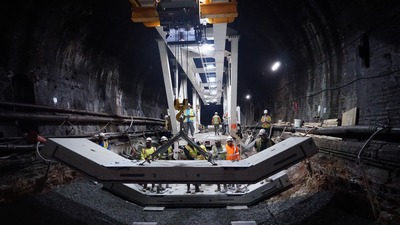
Today, a range of techniques are emerging to help extend the life of older tunnel infrastructure. Among them, invert lowering—the process of deepening the tunnel floor to create additional clearance while preserving the arch and walls—can play a role when combined with advanced modeling tools and innovative construction methods. Within a collaborative, progressive design-build environment, such approaches help owners improve the long-term serviceability of existing tunnels.
The real challenge is doing this safely. Excavating beneath historic footings, working within tight spaces, and managing complex ground conditions require precision and predictability that traditional methods struggle to deliver.
Advancing tunnel rehabilitation
Designers and contractors are joining forces to develop innovative precast concrete systems with advanced ground–structure interaction modeling, offering faster installation, reduced excavation requirements, and the flexibility to adapt to variable profiles typical of older tunnels. These design improvements build on advances in geo-structural modeling, making it possible to simulate construction sequences with far greater accuracy.
The real breakthrough is the ability to model excavation and installation in three dimensions. Using tools such as hardening soil models and staged excavation macros, engineers can:
- Predict how the ground and tunnel lining will respond to each step of excavation.
- Optimize advance lengths to take advantage of natural arching effects.
- Evaluate internal forces within the precast units.
- Assess potential impacts on adjacent structures, utilities, or transit lines.
These advances raise practical questions for owners:
Is an approach such as invert modification a worthwhile investment? How does it compare to rebuilding the tunnel entirely? What are the implications for day-to-day operations while the work is underway?
Full reconstruction may solve the clearance issue, but it often comes with years of disruption and a price tag that may be difficult to justify. When the existing structure is fundamentally sound, more focused solutions can deliver comparable operational benefits at a significantly lower cost, within a manageable construction window that minimizes service disruptions and downtime.
Longevity is another key factor. Owners understandably want to know whether these approaches merely buy time or meaningfully extend the tunnel service life. When supported by advanced modeling, targeted upgrades can position the tunnel for reliable, long-term operation in the future.
This integrated, collaborative approach brings designers and contractors together to give owners a clearer understanding of the risks and expected outcomes in tunnel rehabilitation projects.
Around the world, transportation agencies face similar challenges: aging tunnels, constrained corridors, and the need to increase capacity without long service disruptions. The combination of precast systems, rigorous modeling, and progressive design-build delivery offers a repeatable, scalable approach that aligns design intent with contractor means and methods for modernizing tunnels.
Whether accommodating larger rolling stock, improving drainage, rehabilitating deteriorated inverts, or extending the service life of tunnels, these approaches help owners strike a balance between design goals and practical construction constraints.
Building the next century of service
As cities expand and rail networks evolve, aging tunnels must meet new standards for safety, clearance, and reliability. Innovative rehabilitation strategies, including invert lowering where appropriate, enable owners to meet these modern requirements while preserving the usefulness and heritage of existing tunnels.
We combine advanced engineering tools with a deep respect for historic craftsmanship to help clients in every region extend the service life of critical tunnel infrastructure for generations to come. A recent example is the 130-year-old Howard Street Tunnel in Baltimore, Maryland, where invert lowering played a pivotal role in a broader infrastructure upgrade effort, delivered through close, innovative collaboration with contractors.
Join the conversation
We will be sharing insights from this project at the World Tunnel Congress, May 15–21, 2026. Connect with us to learn how these approaches can help you futureproof your own tunnel assets.About the author

Gary Kramer
Senior Tunnels Consultant, Tunnels
Gary is a senior tunnelling professional with 40 years of experience in construction management, project, and design delivery on large, multidisciplinary tunnel projects across North America, Australia, and South Africa. His work spans water conveyance, transit, highways, rail, sewage, intakes, outfalls, and hydroelectric infrastructure. Gary serves as Senior Technical Advisor, focusing on project delivery and technical excellence. He has held key leadership roles on more than 120 miles of constructed tunnels using multiple excavation methods.

Saeid Rashidi
Regional Director, Tunnels
Saeid, with more than 30 years of experience, has led diverse design teams and excels in delivering complex infrastructure projects. His expertise spans tunnel and underground structure engineering for transportation (rail, transit, road), wastewater, and water. Saeid's work includes tunnel liner design, rehabilitation, construction methods, and bridge design. As a Design Manager and Team Leader, he has contributed to several underground projects and authored multiple technical papers.