Rethinking fire resilience in underground infrastructure
By Amir Golpaygan|April 27, 2026
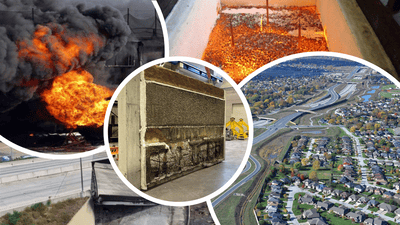
Anyone who has worked in or around tunnels knows how quickly a fire can turn conditions from manageable to extreme. Heat accumulates rapidly. Ventilation becomes a defining variable. And reinforced concrete—the material we rely on most—starts to change in ways that can be both sudden and severe. Strength drops. Stiffness erodes. In minutes, spalling can strip away concrete surface layers and expose reinforcing steel to elevated temperatures.
Spalling isn’t a cosmetic issue. It’s a structural one. It fundamentally alters how a structure carries load. That’s why fire resilience in underground infrastructure cannot be treated as a compliance checkbox. It must be embedded in how we think about design, risk, and long-term asset performance.
Spalling isn’t a cosmetic issue. It’s a structural one. It fundamentally alters how a structure carries load. That’s why fire resilience in underground infrastructure cannot be treated as a compliance checkbox. It must be embedded in how we think about design, risk, and long-term asset performance.
Why a new perspective is needed
For decades, the industry has leaned on standardized time–temperature curves to represent fire exposure. While useful, these curves were developed based on a generic approach and were never meant to capture specific requirements and the realities of a confined underground fire. They assume uniform heating of all surfaces. They don’t account for ventilation or airflow. They ignore geometry, slope, and the way hot gases cling to the ceiling and move through a tunnel. And they often represent worst-case conditions that may not reflect actual risk.As underground systems grow more complex, with new materials, operational patterns, and expectations for resilience, the gap between design assumptions and real fire behavior becomes harder to ignore. The need for fire resilience must keep pace with the complexity of the assets being built. Subsurface infrastructure including tunnels and stations.
That’s why the industry is turning to more advanced methods that reflect how fires truly behave inside a tunnel. Computational Fluid Dynamics (CFD) has become a powerful tool for simulating how heat, smoke, and hot gases move through a confined space. It captures the effects of ventilation, geometry, fuel type, and fire location—factors that can realistically predict temperature profiles along the lining.
When those temperature histories feed into thermo-mechanical structural models, we get what the industry has long needed: a realistic picture of when spalling may begin and progress, and what that means for structural integrity over the duration of the event. It enables better decisions based on how a structure will actually respond, not how a generic curve suggests it might.
What this means for underground assets
For owners and operators, fire resilience ultimately comes down to continuity. A tunnel may remain structurally sound after a fire yet still face a lengthy shutdown if deep spalling leads to months of repairs. By moving toward project-specific assessments, we align design choices with real-world risks. That shift in thinking is reshaping how the industry approaches fire design today. Across the sector, we’re seeing a move toward:- Fire scenarios grounded in operational reality
- CFD-derived temperature profiles calibrated against standard curves
- Material-specific spalling models that accounts for moisture and humidity
- Integrated thermo-mechanical analysis to predict residual strength
- Life cycle-focused resilience planning.
This evidence-based approach is rapidly becoming the new baseline for responsible practice.
Join the conversation
These themes will be explored in depth at the upcoming World Tunnel Congress, where we will share new insights on project-specific fire assessment and structural integrity, including detailed spalling mechanisms and comparisons of key fire curves. For owners, designers, and regulators, it’s an opportunity to engage with emerging best practices and help shape the next generation of fire-resilient underground infrastructure.If you are looking to strengthen the fire resilience of your assets, contact Hatch to discuss how we can partner with you on your next project.