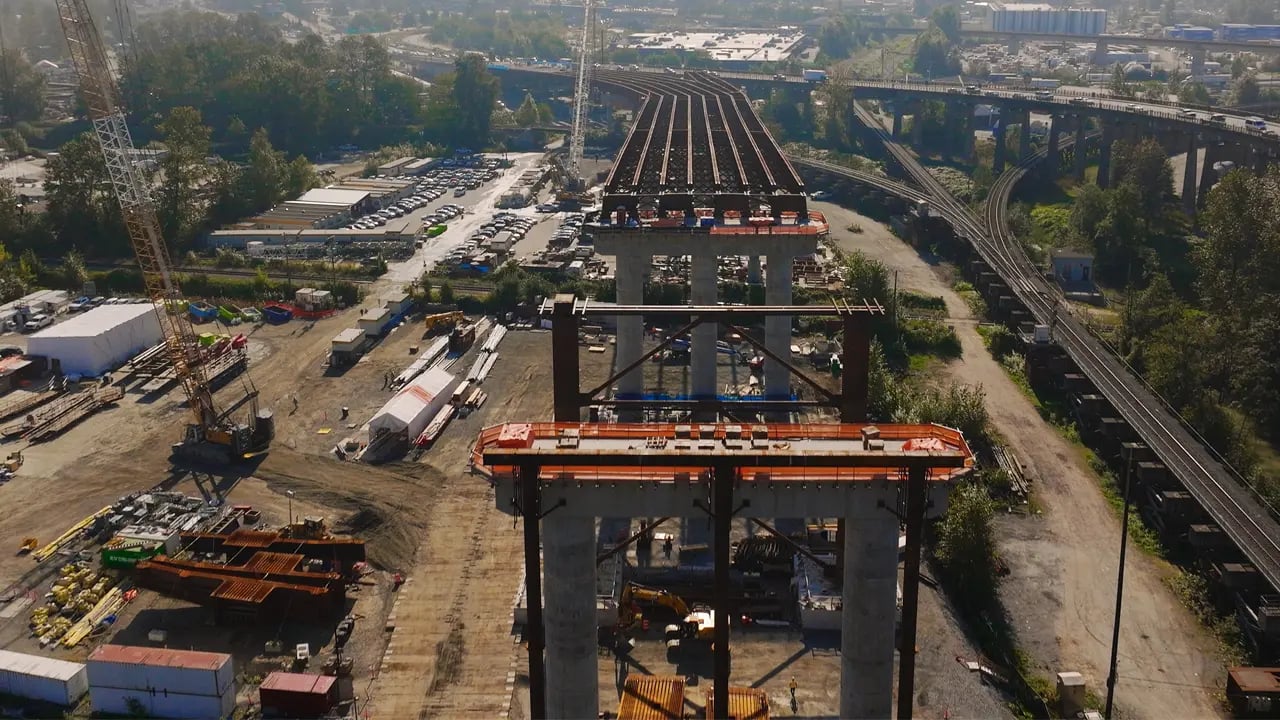
Enhancing safety, resiliency, and sustainability between New Westminster and Surrey, British Columbia.
Fraser Crossing Constructors General Partnership (FCCGP)
|
Greater Vancouver, British Columbia
|
2019 - 2025
Loading component...
Project numbers
This toll-free bridge comprises 4 lanes (designed to allow for a future expansion to six lanes) 1,233 meters long 332-meter clear span 15,000 tons of steel 16 new piers supporting the main bridge and the Highway 17 exit ramp, including two piers in the water, one of which supports the ascending cable tower 3 environmental assessment laws met 6 months of road closures were avoided thanks to SPMT's innovative approach
Built in 1937, the Pattullo Bridge was designed to carry vehicular and pedestrian traffic over the Fraser River and quickly became a crucial link between the cities of Surrey and New Westminster in British Columbia, Canada. As the population of the area grew, it became clear that the bridge, with its narrow lanes and lack of a median barrier, could not safely handle the additional traffic. Mitigation measures were taken where possible to improve safety, but with the bridge exceeding its design life and no longer meeting seismic design requirements, the Province of British Columbia decided to replace the aging structure with the stal̕əw̓asəm (Riverview) Bridge, which fully opened in February 2026.
The Pattullo Bridge Replacement Project delivered a 1,233-meter-long, toll-free, four-lane crossing that improved safety and connectivity for motorists, pedestrians, and cyclists. The stal̕əw̓asəm (Riverview) Bridge was designed to accommodate potential future expansion to six lanes and was constructed with modern, wider lanes separated by a center median barrier. Its cable-stayed design includes a 332-meter main span and dedicated walking and cycling multi-use pathways on both sides of the bridge, encouraging active transportation and improving connections for local communities. Multiple viewing platforms allow the public to enjoy views of the Fraser River—a nod to the natural beauty of the region. The bridge was constructed upstream of the Pattullo Bridge and adjacent to the New Westminster Rail Bridge, a swing bridge that opened in 1904. The project included the decommissioning and removal of the Pattullo Bridge.
We served as the prime design consultant for the project, managing several specialist subconsultants and providing detailed design services for the roadways and structures, including pedestrian bridges, drainage, and utilities. We also provided geotechnical services and supported environmental permitting. The project was funded by the Province of British Columbia, owned by the BC Ministry of Transportation, and delivered by Transportation Investment Corporation—a provincial crown corporation. It was executed as a design-build-finance project, in which we worked with the contractor. This allowed us to produce a design that accommodated the contractor’s construction methods and enabled construction to proceed in parallel with the design.
Replacing the existing Pattullo Bridge was a key infrastructure upgrade for local communities, commuters, and goods movers, and included ecological improvements such as fish habitat offsetting. Given the scope of the project, multiple stakeholder groups were involved throughout delivery, including four railway companies, several utility providers, and local governments. The project took place in an area of great past, present, and future significance to First Nations. First Nations participation in the Pattullo Bridge Replacement Project began in 2016 and continued throughout the construction phase of the project.
A two-pier bridge design significantly reduced the in-river footprint and impact on aquatic life
Our responsibility as the prime consultant for the project was to develop a design for the bridge and its approaches that satisfied all stakeholders’ needs, respected the natural environment, could be built while maintaining existing traffic flow, was cost-effective, and complied with seismic design requirements.
The Fraser River is home to some of the world’s largest salmon populations, including sockeye, pink, chum, chinook, coho, and steelhead, as well as giant white sturgeon and a whole ecosystem of other aquatic and plant life. The protection and conservation of the Fraser River and its wildlife were top priorities for the project team and informed nearly every component of the bridge design and construction. The bridge features just two in-river piers, a significant reduction from the existing bridge’s six, resulting in a much smaller in-river footprint.
Our environmental services experts supported the permitting process for critical approvals under the Fisheries Act, the Canadian Navigable Waters Act, and the Water Sustainability Act. This included revising federal and provincial environmental assessment approvals and securing various smaller permits, critical to avoiding project delays.
Another challenge was addressing an existing overpass that carries Royal Avenue, a key local roadway, over the traffic lanes of the project’s north approach to the bridge. We performed a condition assessment on the overpass and determined that the abutments could be rehabilitated but the superstructure required complete replacement.
An innovative approach saved more than six months of road closures and traffic detours
An extended closure of the bridge connector would create gridlock in the area, so a design that minimized downtime of the road was critical. We worked with the contractor to develop a design that could use self-propelled modular transporters (SPMTs)—computer-operated, multi-axle platforms capable of carrying large, heavy loads like those used on Kenmare Resources’ Moma Mine—to accelerate the replacement of the overpass deck. The existing overpass deck was jacked up then, using an SPMT, removed as a single unit to a staging area for demolition. The new superstructure was prefabricated adjacent to the bridge connector and then lifted and moved into place using the SPMT.
The entire demolition and erection of the new overpass superstructure was performed in a single weekend—saving more than six months of road closures and traffic detours.
Our involvement with the bridge extended beyond the detailed design phase, including field reviews and technical support during the construction process, as well as Engineer of Record (EoR) sign-off and ancillary EoR services until the project was completed and handed over to the owner. Our environmental services experts supported the preparation of monthly and annual compliance reports and tracked adherence to permit conditions to verify compliance with regulatory requirements.
The Pattullo Bridge Replacement Project demonstrated the value of innovation, collaboration, and technical excellence. The lessons learned and innovations developed throughout delivery continue to inform future infrastructure projects across Canada and beyond.